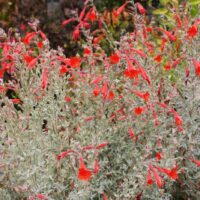
Epilobium canum ‘Carman’s Grey’
We love California fuchsias and have grown this cultivar for over twenty years. Valued for their beauty and important late season nectar source for hummingbirds, California fuchsias offer many forms and foliage colors. 'Carman's Grey' has gorgeous grey foliage which contrasts beautifully with the masses of orangey-red, tubular flowers, late summer and fall. The grey, narrow leaves form soft mounds 2 foot tall, spreading by underground rhizomes, 4 foot or so wide. Plant in full sun to very light shade where it is tolerant of many soil types, even heavy clay, drought tolerant, but best with occasional summer watering. Hummingbird magnet and bees use it too.
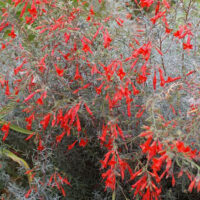
Epilobium canum ‘Catalina’
An outstanding selection of California fuchsia growing 3 ft. tall or more. This may be the tallest cultivar available, sometimes reaching as much as 5 ft. tall. The foliage is silvery-gray with an abundance of large, brilliant orangey-red tubular flowers late summer through fall. This species from southern California is particularly drought tolerant. Hummingbird favorite. Flowers best with occasional deep watering. Pruning plants down to a few inches in late autumn helps to rejuvenate them for the following year.
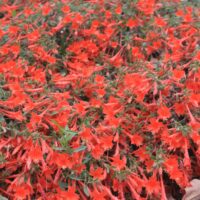
Epilobium canum ‘Cloverdale’
This form of California fuchsia was selected by U.C. Santa Cruz Arboretum from along the Russian River north of Cloverdale. Low, slightly mounding fuzzy olive-green foliage with an abundance of orangey-red tubular flowers the hummingbirds love. Usually stays bellow one ft. in height. 'Cloverdale' is one of the most orange selections of California fuchsia. Plant in full sun. Flowers best with occasional deep watering. Pruning plants down to a few inches in late autumn helps to rejuvenate them for the following year.
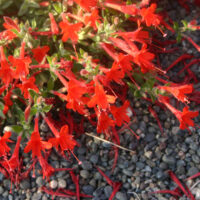
Epilobium canum ‘Everett’s Choice’
A low, spreading form of Californica fuchsia staying below one ft. in height. Distinctive for its fuzzy, gray-green foliage with many scarlet tubular flowers from summer through to fall. Good for sunny areas, though tolerates light shade. Flowers best with occasional deep watering. Attracts hummingbirds. Pruning plants down to a few inches in late autumn helps to rejuvenate them for the following year.

Epilobium canum ‘John Bixby’
A Rancho Santa Ana Botanic Garden introduction, 'John Bixby' is a chance seedling of Epilobium 'Everett's Choice'. Forming a broad patch with a dense rounded form of grey-green foliage 12 -18 inches tall or more. Showy, vivid red-orange tubular flowers put on a spectacular display from summer into fall and are highly attractive to hummingbirds. Vigorous perennial, spreading by underground rhizomes to form large colonies. Plant in full sun to light shade with occasional deep watering for best appearance. Cutting plants down after flowering rejuvinates them for the following year.
Epilobium canum ‘Liz’s Choice’
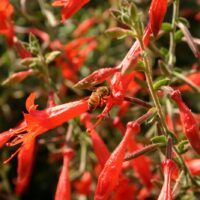
This selection of California fuchsia features particularly large, trumpet-shaped, scarlet flowers atop stems reaching 3 ft. tall. The flowers, blooming from summer into fall, are a favorite of hummingbirds and bees. The lance-shaped leaves are a pewter green, providing a striking contrast to the brilliant flowers. It spreads over time to create small colonies. Trim plants down to about 4 inches in winter for vigorous, tidy growth the next year. Provide moderate to infrequent irrigation and full sun. This beautiful cultivar was selected by Milo Baker Chapter CNPS Fellow Liz Parsons.
Epilobium septentrionale ‘Select Mattole’
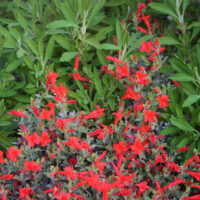
This California fuchsia forms tidy, low, 6 inch high mats of beautiful silver foliage with a matte finish. Late summer through fall brings orangey-red tubular flowers which attract hummingbirds. A somewhat redder flowering selection. Spreading by underground rhizomes, this Epilobium increases a little less vigorously than the others. Full sun to light shade. More shade tolerant than most California fuschias. Needs more water than most Epilobiums. Pruning plants down to a few inches in late autumn helps to rejuvenate them for the following year.
Erythranthe (Mimulus) cardinalis
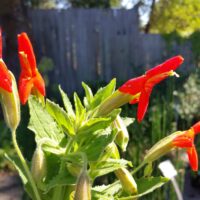
Native to wet areas throughout the West, this robust perennial can easily grow to more than 2 ft. tall and wide. Tubular scarlet flowers are a hummingbird favorite and are very showy. Plant in sun to part shade with ample water. Perfect beside a pond, stream or water feature. Trim as needed to keep tidy. The flowers provide nectar for hummingbirds.
Euonymus occidentalis
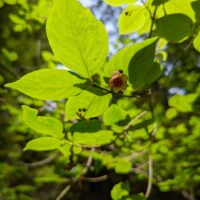
Native to moist canyons, the uncommon western burning bush features small, burgundy flowers in the spring followed by dangling orangey-red fruits. The subtle appeal of this medium sized, deciduous shrub will please those native plant enthusiasts looking for a rare find. Reaches a height and width of about 8 ft. in most garden settings and is amenable to pruning. Plant in part shade to full shade. Enjoys moist situations but may become tolerant of drought in shadier locations. Needs good drainage.
Gambelia (Galvezia) speciosa
Evergreen shrub native to the Channel Islands off the So. California coast. Forms an arching mound of medium green foliage 3-4 ft. tall x 5 ft. wide, but can climb or lean on other shrubs to grow even taller. Clusters of scarlet, tubular flowers decorate the branch tips in spring and intermittently throughout the year and are adored by hummingbirds. Full sun along the coast, light shade in hot areas. Drought tolerant and amenable to pruning. Hardy to around 20°F.
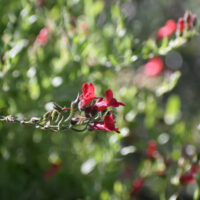
Gambelia (Galvezia) speciosa ‘Firecracker’
An interesting, evergreen subshrub from the California Channel Islands. Showy, deep-red, tubular flowers decorate the branch tips and are highly attractive to hummingbirds. The cultivar ‘Firecracker’ was selected by Tree of Life Nursery for its compact habit, growing 3 foot tall and 5 foot wide, with fuzzy, pale green leaves and larger, red, snapdragon-like flowers. A natural along the coast where it will grow in full sun to light shade, afternoon shade is best in hotter inland sites. Drought tolerant once established, but enjoys occasional summer water, especially away from the coast. Hardy to 15 -20 degrees F.
Heuchera ‘Santa Ana Cardinal’
An outstanding hybrid that is vigorous and free flowering. Compact clumps of foliage topped with 2 ft. tall flowering stems with vibrant rose-red blossoms over a long period. Plant in cool full sun to light shade with moderate to occassional summer water once established. This species attracts hummingbirds.
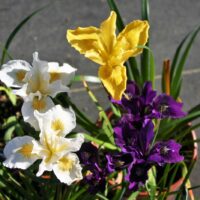
Iris Pacific Coast hybrid
A diverse group bred from the native irises with wonderful coloration, patterning, flower form variation....ranging from soft pastels to mahogany, maroon and midnight purple. Evergreen foliage, about 1 to 2 ft. high. Can eventually form sizable clumps. Full sun to light shade. Often do well as an understory for oaks that needs no summer water. Drought tolerant, moderate to little water when established. Deer don’t seem to eat flowers or foliage.
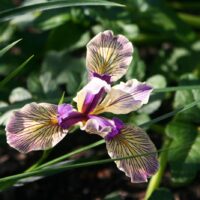
Iris Pacific Coast hybrid ‘Sebastopol’
A diverse group bred from the native irises with wonderful coloration, patterning, flower form variation....ranging from soft pastels to mahogany, maroon and midnight purple. Evergreen foliage, about 1 to 2 ft. high. Can eventually form sizable clumps. Full sun to light shade. Often do well as an understory for oaks that needs no summer water. Drought tolerant, moderate to little water when established. Deer don’t seem to eat flowers or foliage.
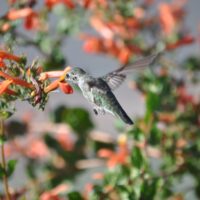
Keckiella cordifolia
This Penstemon relative produces a profusion of bright red-orange, tubular flowers on the branch tips late spring into summer which are adored by hummingbirds. It likes to climb through tall chaparral shrubs or spill down slopes. Forms an open arching mound 3 ft. by 3 ft. but can climb 6 ft. or more. Deciduous with winter cold or summer drought, semi-evergreen in milder coastal regions. Requires good drainage in sun to part shade. Moderate to little summer water. Deer resistant.
Lepechinia hastata
A bold and beautiful sage relative which grows 4’-6’ tall and slowly spreads to form a small thicket. Large, fragrant, grey-green leaves are an excellent foil to the reddish-purple flowers which appear on branch tips in summer and early fall. Great in the flower border or out in the “wild” part of the garden. Easy and tough. Full sun to light shade with moderate to occasional water. Looks best when cut to the ground after blooming is done. Attractive to hummingbirds. Deer don’t seem to eat it.
Lewisia cotyledon
Named for Meriwether Lewis, this attractive succulent is native to higher elevations in Northern California and Southern Oregon, typically granite outcrops. The flowers which usually emerge in spring and summer, can range in color from yellow to orange to pink to red. These frost hardy plants form evergreen rosettes, approx. 8 - 10” tall by a foot or so wide. Lewisias need very good, sharp drainage, are heavy feeders, and love a granite rock mulch. They like to be grown sideways, in rock walls, where their crown can drain any moisture away. Plant somewhat high in a fast draining mix and feed every now and then. Morning sun, afternoon shade is best inland. Water as you would any succulent, sparingly, and keep the crown high and dry.
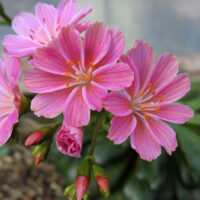
Lewisia cotyledon – Sunset Strain
Named for Meriwether Lewis, this attractive and showy succulent is native to higher elevations in Northern California and Southern Oregon, typically on granite outcrops. Abundant floral sprays arise in spring and summer on stalks reaching 6-10" above evergreen foliage. This seed strain has produced a rainbow of flower colors, including: yellow, white, orange, pink and red. The frost hardy rosettes grow to approx. 8-10” tall by a foot or so wide. Lewisias need very good, sharp drainage, and love a granite rock mulch. They like to be grown sideways, in rock walls, where excess moisture drains away. Plant somewhat high in a fast-draining mix and feed every now and then. Morning sun with afternoon shade is best inland. Water sparingly, as you would any succulent, and keep the crown dry.
Lewisia longipetala ‘Little Raspberry’
The parent of this strain of Lewisias is found in rocky outcroppings of the Sierra Nevada Mts. Forms low, fleshy rosettes of tough evergreen leaves. Raspberry-red flowers bloom on short stems above the leathery foliage in the spring into summer and often again in the autumn. Requires good sharp drainage and rock mulch, but appreciates partial shade in hot summer areas. Perfect for rock walls, rock garden, containers and troughs. Water as you would any succulent, sparingly, and keep crown high and dry. This is not the plant for your perennial border, but it is easy to make happy in containers.
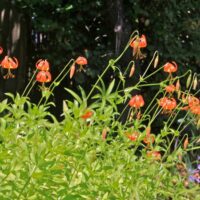
Lilium pardalinum
An elegant and beautiful native from moist places and along stream banks in many plant communities from southern Oregon to southern California. A reliable species easily growing 4 ft. tall or more, slowly increasing its width over time. The Turk’s cap style flowers bloom in summer and are orange with red tips and maroon spots. Dies back to the ground in winter. Prefers fertile, well drained soils. Where summers are cool you can plant in full sun. Elsewhere plant in filtered sun, light shade or afternoon shade. Requires moderate summer water.
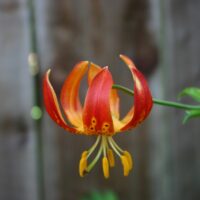
Lilium pardalinum ‘Giganteum’
A towering lily reaching up to 7 feet tall with orange and crimson flowers 3 to 4 inches wide. Who can resist that! Believed to have been discovered along the Van Duzen River in Northern California and thought to be a natural cross between L. humboldtii and L. pardalinum. The large stalks are crowned in summer by layers of flowers up to 30 in number with whorls of large leaves ascending up the base. Forms colonies over time to dramatic effect. Plant in full sun near the coast but protect from the hot afternoon sun, inland. Needs moderate water but is intolerant of soggy soils. Tolerates drier soil than the typical leopard lily.
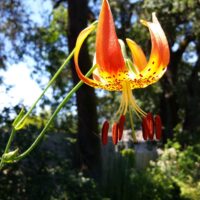
Lilium pardalinum (Gualala River)
An elegant and beautiful native from moist places and along stream banks in many plant communities from southern Oregon to southern California. A reliable species easily growing 4 ft. tall or more, slowly increasing its width over time. The Turk’s cap style flowers bloom in summer and are orange with red tips and maroon spots. Dies back to the ground in winter. Prefers fertile, well drained soils. Where summers are cool you can plant in full sun. Elsewhere plant in filtered sun, light shade or afternoon shade. Requires moderate summer water.
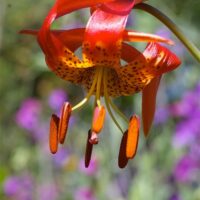
Lilium pardalinum ssp. pitkinense
This is the local rare subspecies of the leopard lily, threatened by habitat loss, grazing, competition with Himalayan blackberries, and collecting. Ours are responsibly grown by scale division from seed grown parent plants. A beautiful turks cap lily with intense orange-red reflexed petals revealing maroon spots. Needs moisture until it's through flowering and protection from gophers. Bright shade or morning sun with afternoon shade is best. This species attracts hummingbirds and butterflies.
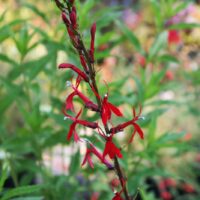
Lobelia cardinalis
Cardinal flower is native to wet places throughout much of North America. A hummingbird favorite with show stopping, intense scarlet-red tubular flowers on erect terminal spikes in late summer. Growing 2 - 3 ft. tall by 2 ft. wide, this clump-forming perennial has dark green, serrated leaves. Tends to be rather short lived, but is a strong re-seeder. Prefers areas with constant moisture and cool sun to part shade, affective in moist areas of woodland gardens, meadows, pond edges, and rain gardens. Attracts hummingbirds and butterflies, but is resistant to deer browse.
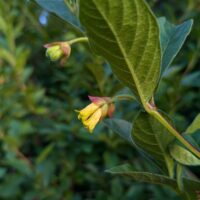
Lonicera involucrata
An interesting native shrub that grows along streams and other moist places. The tubular, red and yellow flowers are borne in pairs on bright red bracts and are hummingbird favorites. Two black shiny fruits follow the flower and are very showy set against the red bracts, making them attractive to birds. Reaches 6 - 10 ft. tall and wide, this neatly branched shrub loses its leaves in the winter. A great addition to the habitat garden in full sun to light shade with regular to occasional deep summer water. Orioles love the fruits. Needs afternoon shade in hot, inland areas. Deer resistant.
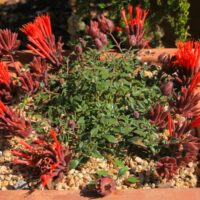
Monardella macrantha ‘Marian Sampson’
A choice native perennial forming low mats of fragrant dark green shiny leaves. Mid to late spring brings spectacular heads of scarlet tubular flowers which are hummingbird magnets. Well suited for rock garden or container use where good drainage can be provided along with occasional summer water. Appreciates light shade in hot regions. The cultivar ‘Marian Sampson’ is a vigorous and disease resistant selection, but still likely to be short lived, lasting 2 to 4 years. Fantastic accent plant which is deer resistant and attractive to butterflies and hummingbirds.
Myrica hartwegii
From Sierran streambanks comes this sweet bay, a cousin of our local wax myrtle. Rare in nature, this deciduous shrub can reach a height and width of up to 5 ft. Soft, lance-shaped leaves of gray-green flank the stems. Small red flowers appear in the spring. Enjoys dappled shade and good drainage. Requires regular irrigation. Plant with indian rhubarb, western columbine and ferns for a taste of the mountains in your own garden. Thought to be deer resistant.
Penstemon barbatus
Native to sunny, hot, rocky slopes from Utah and Colorado to Texas and Mexico, this striking penstemon is a willing grower. Forms a low mound of lush foliage, topped with 4 ft. tall, erect flower spikes of brilliant, scarlet, tubular blossoms, providing a bold splash of color in beds, borders, rock garden or meadow planting. Plant in full sun with good drainage where it will be drought tolerant once established. Flowers adored by hummingbirds and butterflies. Deer resistant.
Penstemon barbatus ‘Red Riding Hood’
Trumpet-shaped blossoms of coral-red arise on thick stems up to 2 ft. high on this Dutch selection of the beardlip penstemon. Originating from the American Southwest, this superlative species offers flowers from late spring to the end of summer, enticing hummingbirds, bees and butterflies into the garden. Light green, lanceolate leaves grow densely at the base and climb up the stout stalks. This selection has proven to be very garden tolerant, liking full sun and moderate to infrequent irrigation.
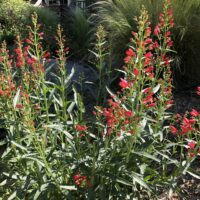
Penstemon barbatus ‘Riding Hood Red’
Trumpet-shaped blossoms of coral-red arise on thick stems up to 2 ft. high on this Dutch selection of the beardlip penstemon. Originating from the American Southwest, this superlative species offers flowers from late spring to the end of summer, enticing hummingbirds, bees and butterflies into the garden. Light green, lanceolate leaves grow densely at the base and climb up the stout stalks. This selection has proven to be very garden tolerant, liking full sun and moderate to infrequent irrigation.