
Epilobium canum ‘John Bixby’
A Rancho Santa Ana Botanic Garden introduction, 'John Bixby' is a chance seedling of Epilobium 'Everett's Choice'. Forming a broad patch with a dense rounded form of grey-green foliage 12 -18 inches tall or more. Showy, vivid red-orange tubular flowers put on a spectacular display from summer into fall and are highly attractive to hummingbirds. Vigorous perennial, spreading by underground rhizomes to form large colonies. Plant in full sun to light shade with occasional deep watering for best appearance. Cutting plants down after flowering rejuvinates them for the following year.
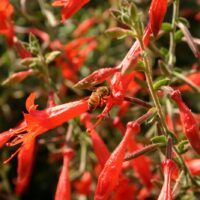
Epilobium canum ‘Liz’s Choice’
This selection of California fuchsia features particularly large, trumpet-shaped, scarlet flowers atop stems reaching 3 ft. tall. The flowers, blooming from summer into fall, are a favorite of hummingbirds and bees. The lance-shaped leaves are a pewter green, providing a striking contrast to the brilliant flowers. It spreads over time to create small colonies. Trim plants down to about 4 inches in winter for vigorous, tidy growth the next year. Provide moderate to infrequent irrigation and full sun. This beautiful cultivar was selected by Milo Baker Chapter CNPS Fellow Liz Parsons.

Epipactis gigantea
Here’s a native orchid that’s easy in cultivation. In time it will form a colony producing many flower stems. Each stem holds several interesting orchid blossoms of subtle orange, coral and green tones 12 - 18 inches tall. Dies back to the ground in winter. Best with decent drainage and regular to moderate moisture (NOT soggy soils) and dappled shade part of the day. Wonderful addition to the woodland garden, around pond or near streams. Good in containers too.
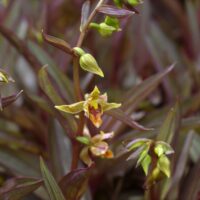
Epipactis gigantea ‘Serpentine Night’
The stream orchid is found in perennial streams, seepages, or other permanently moist places in California. Spreads by runners and will form a colony producing many flower stems. Each stem holds several orchid blosssoms of subtle orange tones 12 - 18 inches tall. The cultivar ‘Serpentine Night’ has wonderful dark purple foliage, emerging in the spring almost black. As the season progresses the color changes to dark bronze then bronzy green. Goes dormant in winter. Best with good light but may need afternoon shade in hot areas. Easy to grow with regular to moderate water. Excellent in containers.
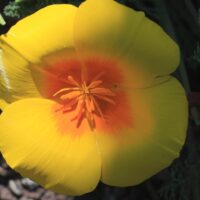
Eschscholzia californica var. maritima
This is the perennial, coastal form of California poppy. Low growing and spreading with beautiful, finely cut, blue-gray foliage. Abundant flowers are golden yellow with orange centers, blooming over a long period, especially in mild climates. Plants retreat to leafy rosettes in winter. Best in full sun where they are drought tolerant, but a little summer water can extend their bloom period. Seeds about if happy.
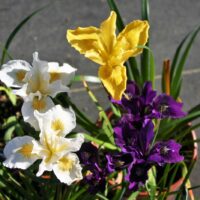
Iris Pacific Coast hybrid
A diverse group bred from the native irises with wonderful coloration, patterning, flower form variation....ranging from soft pastels to mahogany, maroon and midnight purple. Evergreen foliage, about 1 to 2 ft. high. Can eventually form sizable clumps. Full sun to light shade. Often do well as an understory for oaks that needs no summer water. Drought tolerant, moderate to little water when established. Deer don’t seem to eat flowers or foliage.
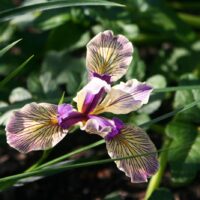
Iris Pacific Coast hybrid ‘Sebastopol’
A diverse group bred from the native irises with wonderful coloration, patterning, flower form variation....ranging from soft pastels to mahogany, maroon and midnight purple. Evergreen foliage, about 1 to 2 ft. high. Can eventually form sizable clumps. Full sun to light shade. Often do well as an understory for oaks that needs no summer water. Drought tolerant, moderate to little water when established. Deer don’t seem to eat flowers or foliage.
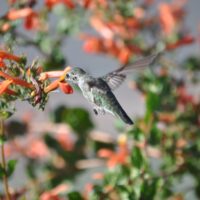
Keckiella cordifolia
This Penstemon relative produces a profusion of bright red-orange, tubular flowers on the branch tips late spring into summer which are adored by hummingbirds. It likes to climb through tall chaparral shrubs or spill down slopes. Forms an open arching mound 3 ft. by 3 ft. but can climb 6 ft. or more. Deciduous with winter cold or summer drought, semi-evergreen in milder coastal regions. Requires good drainage in sun to part shade. Moderate to little summer water. Deer resistant.
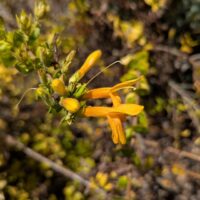
Keckiella cordifolia – orange-flowered form
Climbing penstemon is a striking flowering shrub with an open-arching form, and profuse penstemon-like blooms that are adored by hummingbirds. In this sunny selection, the bright, pollinator-attracting blossoms are a lighter, yellow-orange rather than the more typical scarlet. Slender branches of heart-shaped leaves, laden from late spring into summer with tubular flowers, naturally reach vine-like over nearby shrubs, cascade down slopes, or sprawl between rocks. Can be pruned to stay 3 feet or so, or allowed to climb and spread more than 6 ft.. Native to coastal Southern California, it is semi-evergreen in mild climates, but deciduous inland with winter cold or summer drought. Requires good drainage with coastal sun, but part shade in inland heat. Moderate to little summer water. An excellent deer-resistant habitat plant.
Lewisia cotyledon
Named for Meriwether Lewis, this attractive succulent is native to higher elevations in Northern California and Southern Oregon, typically granite outcrops. The flowers which usually emerge in spring and summer, can range in color from yellow to orange to pink to red. These frost hardy plants form evergreen rosettes, approx. 8 - 10” tall by a foot or so wide. Lewisias need very good, sharp drainage, are heavy feeders, and love a granite rock mulch. They like to be grown sideways, in rock walls, where their crown can drain any moisture away. Plant somewhat high in a fast draining mix and feed every now and then. Morning sun, afternoon shade is best inland. Water as you would any succulent, sparingly, and keep the crown high and dry.
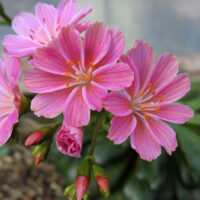
Lewisia cotyledon – Sunset Strain
Named for Meriwether Lewis, this attractive and showy succulent is native to higher elevations in Northern California and Southern Oregon, typically on granite outcrops. Abundant floral sprays arise in spring and summer on stalks reaching 6-10" above evergreen foliage. This seed strain has produced a rainbow of flower colors, including: yellow, white, orange, pink and red. The frost hardy rosettes grow to approx. 8-10” tall by a foot or so wide. Lewisias need very good, sharp drainage, and love a granite rock mulch. They like to be grown sideways, in rock walls, where excess moisture drains away. Plant somewhat high in a fast-draining mix and feed every now and then. Morning sun with afternoon shade is best inland. Water sparingly, as you would any succulent, and keep the crown dry.
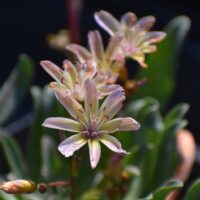
Lewisia longipetala ‘Little Peach’
Large flowers with long petals colored peachy apricot make this selection of our native cliff maids a knockout in the garden. Round clusters of narrow, succulent leaves form patches up to about 8 inches wide. The irresistible flowers emerge en masse from between the leaves on slender stalks up to about 10 inches high. A very long bloomer, beginning in spring and often re-blooming in summer. Works really well in a container with lean, fast draining soil, placed in bright partial shade. Water sparingly. For best results, mulch with granite chips and fertilize occasionally. Lewisias are native to the mountains of California and beyond, where they grow in rock cliffs. An excellent choice for the rock garden.
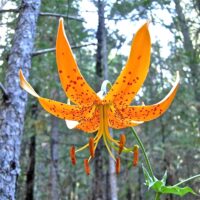
Lilium humboldtii ‘ssp. humboldtii’
From the mountains of northern California comes this dramatic, drought tolerant lily, reaching upwards of 10 feet tall in its native habitat of chaparral and open forest. Lowland gardeners can expect a height of 6 feet or so. Large, orange flowers with magenta spots form many stately tiers around the robust stalks with lance-shaped leaves climbing up the base in tidy whorls. Give this rare lily excellent drainage and withhold summer water. Plant in dappled shade.
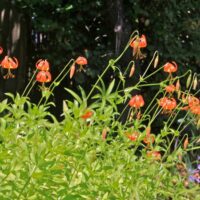
Lilium pardalinum
An elegant and beautiful native from moist places and along stream banks in many plant communities from southern Oregon to southern California. A reliable species easily growing 4 ft. tall or more, slowly increasing its width over time. The Turk’s cap style flowers bloom in summer and are orange with red tips and maroon spots. Dies back to the ground in winter. Prefers fertile, well drained soils. Where summers are cool you can plant in full sun. Elsewhere plant in filtered sun, light shade or afternoon shade. Requires moderate summer water.
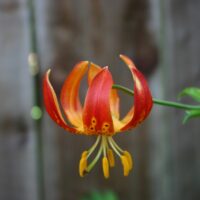
Lilium pardalinum ‘Giganteum’
A towering lily reaching up to 7 feet tall with orange and crimson flowers 3 to 4 inches wide. Who can resist that! Believed to have been discovered along the Van Duzen River in Northern California and thought to be a natural cross between L. humboldtii and L. pardalinum. The large stalks are crowned in summer by layers of flowers up to 30 in number with whorls of large leaves ascending up the base. Forms colonies over time to dramatic effect. Plant in full sun near the coast but protect from the hot afternoon sun, inland. Needs moderate water but is intolerant of soggy soils. Tolerates drier soil than the typical leopard lily.
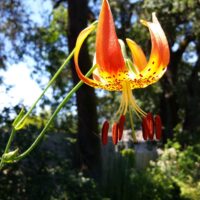
Lilium pardalinum (Gualala River)
An elegant and beautiful native from moist places and along stream banks in many plant communities from southern Oregon to southern California. A reliable species easily growing 4 ft. tall or more, slowly increasing its width over time. The Turk’s cap style flowers bloom in summer and are orange with red tips and maroon spots. Dies back to the ground in winter. Prefers fertile, well drained soils. Where summers are cool you can plant in full sun. Elsewhere plant in filtered sun, light shade or afternoon shade. Requires moderate summer water.
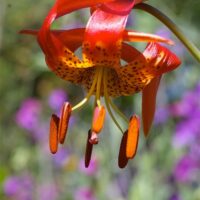
Lilium pardalinum ssp. pitkinense
This is the local rare subspecies of the leopard lily, threatened by habitat loss, grazing, competition with Himalayan blackberries, and collecting. Ours are responsibly grown by scale division from seed grown parent plants. A beautiful turks cap lily with intense orange-red reflexed petals revealing maroon spots. Needs moisture until it's through flowering and protection from gophers. Bright shade or morning sun with afternoon shade is best. This species attracts hummingbirds and butterflies.
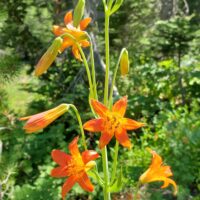
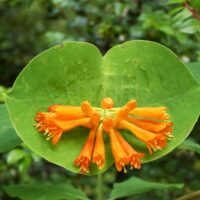
Lonicera ciliosa
Native to north slopes, creeks and river banks from very northern California to British Columbia and Montana. Lovely blue-green, oval-shaped leaves on rapidly growing woody stems will clamber up any support it can find. Terminal flower clusters with narrow, trumpet-shaped, orange flowers are adored by hummingbirds. Red translucent fruits follow that are relished by birds. Plant in cool sun to moderate shade with regular water. Possibly deer resistant.
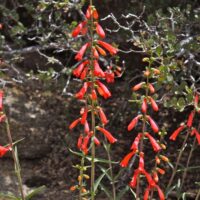
Penstemon centranthifolius
Custom made for hummingbirds, this Penstemon sports an abundance of bright-red to orange-red tubular flowers from late spring into summer. Native to dry habitats in the North Coast Ranges south to Mexico and east to the Southern Sierra, growing in chaparral and openings in woodlands below 6000 ft. Thick, blue-green leaves form a rosette 1 – 2 ft. tall and wide. Long flower spikes rise 2 – 4 ft. above the waxy leaves with many narrow, tubular, scarlet blossoms. Likes full sun, lean soils and good drainage. Drought and cold tolerant. Hummingbird and butterfly favorite.
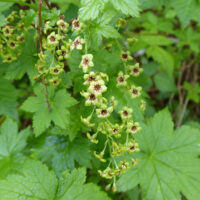
Ribes bracteosum
Native from Mendocino County northwards, this deciduous shrub is distinctive for its long, upright inflorescences and large, shiny leaves up to eight inches wide. As many as fifty of the soft orange, saucer-shaped flowers can occur on a single stem in the spring followed by small blue fruits in late summer. In shaded, moist conditions the blue currant can reach a height and width of about six feet but can get larger in cool, wet areas along the coast. Combine with other plants of the redwood forest such as ferns, sorrel and wild ginger.
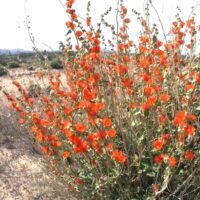
Sphaeralcea ambigua
Native to desert plant communities, apricot mallow is a showy evergreen shrublet growing 2-4 foot tall and wide. Soft-green, woolly, scalloped leaves provide the foil for long wands with an abundance of small hollyhock-like flowers in delicious shades of orange. Plant in full sun with good drainage and occasional summer water. Adaptable, tolerating cold, dry conditions but not heavy wet soils. When happy can bloom for months- trim back flowering stems after bloom for repeat performance. A beautiful addition to the dry sunny garden, ideal for inland gardens. Relatively short lived but grows rapidly and occasionally reseeds. Honeybees, native bees and hummingbirds are attracted to its flowers.