
Abutilon palmeri
Lovely, tangerine-orange flowers and fuzzy, grey-green, heart-shaped leaves make this evergreen native a real treat for the gardener. The cup-shaped blossoms appear throughout spring, attracting butterflies, followed by striking seed pods which can accent flower arrangements. A smallish shrub, reaching 4 – 5 ft tall and wide, suitable for full sun or part shade. Plant in soil with decent drainage and water infrequently once established. While native to Southern California, it does well in our area in places which don’t drop below 25F in winter.

Achillea millefolium ‘Terracotta’
This hybrid yarrow forms a mat of grey-green ferny foliage 2 - 3 ft. wide with interesting earth-tone colored flowers. The long-lasting flower clusters simultaneously sport peachy-yellow tones through burnt orange, on sturdy non-floppy stems to around 2 ft. tall. Plant in full sun with moderate to occasional summer water once established. Bees and butterflies love yarrows, but they are not deer favorites. Excellent cut flowers too.

Agastache ‘Coronado Red’
Agastaches are rewarding perennials with fragrant foliage and abundant flowers, which are highly attractive to hummingbirds and butterflies. ‘Coronado Red’ has a vertical growth habit with silvery foliage to 2.5 ft. tall and 2 ft. wide. Spikes of orangy-red flowers bloom over a long period in the summer delighting the hummingbirds. Requires good drainage and full sun with moderate to occasional summer water. Deer resistant.
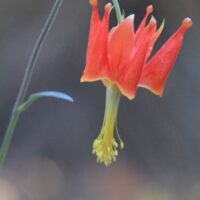
Aquilegia eximia
Large, orangey-red flowers with yellow stamens adorn this beautiful and uncommon native columbine. The pendant, brightly colored blossoms are larger than those of the western columbine but just as attractive to hummingbirds. Forms a 1 ft. high mound of foliage with flowering stalks reaching up to 5 ft. tall. Native to the Coast Ranges from Mendocino to Ventura Counties often on serpentine soils. Provide full sun to part shade and only water enough to prevent the soil from drying out completely. In areas far away from the coast provide a little shade from the hot afternoon sun. This species is a little more drought tolerant than the more common Western columbine.
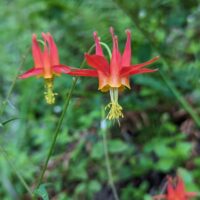
Aquilegia formosa
A popular native perennial with fern-like foliage and wonderful, nodding, spurred blossoms of red and yellow. Best with a little shade and moderate to regular moisture, but will tolerate full sun in somewhat cooler climates. The flower stalks reach 1 1/2’ to 3’ tall, with the grey-green foliage forming a mound of about 1 ft tall and wide. Flowers attract hummingbirds, while the seeds are relished by small birds such as sparrows and Juncos. If seed pods are left on the plants, you may get volunteer seedlings in the fall.
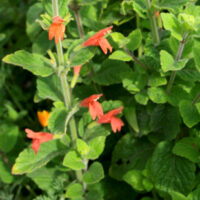
Clinopodium (Satureja) mimuloides
Native to creeksides in the mountains of southern California, this clump forming perennial is rarely seen in cultivation. Growing 2 - 3 ft. tall and wide with soft, fragrant foliage. Orangy-red tubular flowers bloom late spring to early summer and are hummingbird favorites. Plant in sun to light shade with regular moisture.
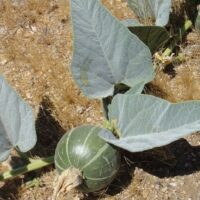
Cucurbita foetidissima
Found in valley grasslands and coastal scrub environments of Central and Southern California, the buffalo gourd is a deciduous perennial ground cover or vine that is sure to grab attention. In late winter and early spring, this vigorously spreading gourd emerges from a tuberous root, potentially spreading to 20’ feet or more, producing big, triangular, gray-green fuzzy leaves, followed by large, showy, orange-yellow, bell-shaped flowers in summer which attract bees. The round fruits, about 4 inches across, are green-striped when young, maturing to yellow. As the fruit matures, it is too bitter for humans to eat. The mature fruit is used by native peoples for decorative purposes or for making musical rattles. Plant in full sun. Drought-tolerant once established.
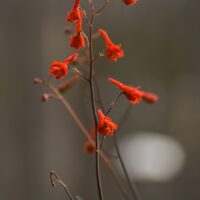
Delphinium nudicaule
In late winter and spring, scarlet flowers with elongated tails perch on upright stalks, usually not more than 3 ft tall. The green, lobed leaves which form a low mound above the ground have a distinctive pale patch in their centers. This native makes its home on summer-dry slopes throughout much of Northern California and parts of Central Ca., inhabiting bright, open woodlands and rocky road cuts. Needs good drainage and little to no irrigation in the summer. While it can grow in a fair amount of shade, it blooms best under a bright, dappled canopy. A favorite of hummingbirds and butterflies. All parts are poisonous if ingested.
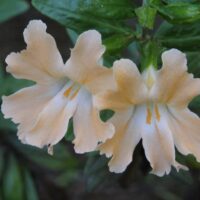
Diplacus (Mimulus) ‘Creamsicle’
The trumpet-shaped blossoms of the 'Creamsicle' monkeyflower are a beautiful, light shade of pastel orange. With their white throats and dark orange nectar guides, the flowers have a two-toned affect. This is one of Phil Van Soelen's first hybrids using Diplacus bifidus from Bowman Lake in the Sierra Nevada (thanks to Ted Kipping). It has proved long lived in both Fulton and Sebastopol and has the useful characteristic of sprouting new growth from the base so that old growth can be pruned away. Evergreen foliage grows 2-3 feet tall and wide. Best with light shade, good drainage, and minimal summer water. Deer resistant.
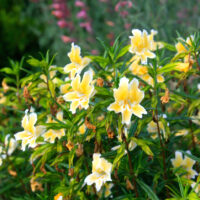
Diplacus (Mimulus) ‘Eleanor’
The ‘Eleanor’ monkeyflower selection, introduced by Yerba Buena Nursery, offers an abundance of soft citrusy-yellow blossoms edged in white. Monkeyflowers are evergreen, floriferous subshrubs that bloom spring through the summer. This hybrid form grows to around 3-foot tall and wide. Best with good drainage, light shade, and occasional deep watering once established. Avoid drip irrigation. Pinching older stems helps produce a fresh, dense habit for these profusely blooming plants. Monkeyflowers are deer resistant, and are a larval food source for the painted lady and checkerspot butterflies.
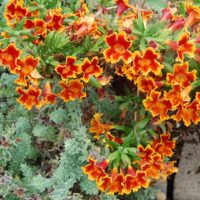
Diplacus (Mimulus) ‘Fiesta Marigold’
Selected for its large, frilly, brick-red blossoms with orange edging, this striking monkeyflower hybrid comes from horticulturalist Richard Persoff. It is also a relatively compact form at 18 inches to 2 feet tall and wide. Valued for their long bloom season, monkeyflowers perform best with good drainage and sun to light shade. Drought tolerant, but some occasional summer water is helpful. Monkeyflowers benefit from pinching to produce a nice shape and strong structure to hold the abundant blossoms. Highly attractive to bees and hummingbirds. Deer resistant.
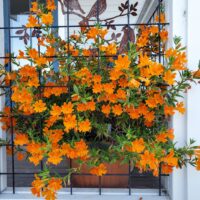
Diplacus (Mimulus) ‘Jelly Bean Orange’
This bright and multi-toned orange selection from the Jelly Bean Series of hybrid monkeyflowers was chosen for its compact habit and heavy display of frilly blossoms. Monkeyflowers are a useful group of free-flowering, drought-tolerant, native sub-shrubs that bloom spring through summer. Provide good drainage, light shade and careful watering. Monkeyflowers do best with an occasional deep watering in the summer and pinching to form good support for the profuse blossoms. Bees, butterflies and hummingbirds work the flowers and the painted lady and checkerspot butterflies use it as a larval food source. Deer resistant.
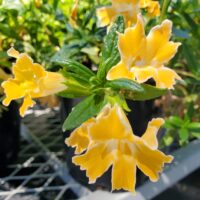
Diplacus (Mimulus) ‘Pamela’
This monkeyflower hybrid offers striking, golden-yellow flowers with white edging. Monkeyflowers are shrubby perennials, beloved for their showy displays of frilly, trumpet-shaped flowers from mid spring through summer. This selection comes from Susan Ashley, a Bay Area grower and instructor of plant propagation. Relatively compact, it will grow 1 to 2 foot tall by 2 foot wide, with narrow, shiny, dark-green foliage. Plant in full sun on the coast to light shade inland, with good drainage. Drought tolerant once established, but occasional deep watering extends the bloom period. Pinching stems helps produce a sturdy structure to hold its abundant blossoms. Highly attractive to bees and hummingbirds, and a larval food source for painted lady and checkerspot butterflies. Deer resistant.
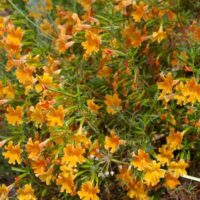
Diplacus (Mimulus) ‘Peach Hybrid’
This dependable monkeyflower hybrid is one of the oldest in our collection. The large, frilly blossoms are a rich peachy-orange and bloom profusely from spring through autumn. Grows 2-3 ft. tall, but benefits from pinching back to keep compact. A drought tolerant shrub that can grow in full sun on the coast to part shade inland. Monkeyflowers require good drainage and respond to occasional watering, but resent drip irrigation systems that deliver water on a regular basis. A larval food source for painted lady and checkerspot butterflies. Deer resistant.
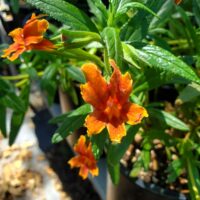
Diplacus (Mimulus) ‘U.C. Hybrid’
A rich-toned hybrid monkeyflower displaying mamalade-orange flowers with contrasting burnished-red throats. Monkeyflowers are 2-3-foot evergreen subshrubs that bloom from spring through summer, and this cultivar is an especially verdant and vigorous form. Does best with good drainage, and prefers afternoon shade inland. Thrives when kept on the dry side with occasional deep summer waterings. Stems can be pinched to form a stronger, denser framework to support its floriferous branches. Hummingbirds, butterflies and bees enjoy the flowers. A larval food source for checkerspot and painted lady butterflies. Deer resistant.
Diplacus (Mimulus) ‘Willits Apricot’
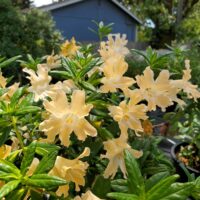
A chance seedling, this apricot-yellow monkeyflower appeared in a Willits garden near plantings of other hybrids. The large, trumpet-like flowers are elegant and buttery-soft in tone. A vigorous and willing grower, the evergreen foliage reaches up to 3 ft. tall and wide. Does well in full sun on the coast to light shade inland, and prefers good drainage. Best with occasional deep watering in the summer and pinching to form good support for the abundant flowers. Bees, butterflies and hummingbirds work the flowers and the painted lady and checkerspot butterflies use it as a larval food source. Deer resistant.
Diplacus (Mimulus) aurantiacus
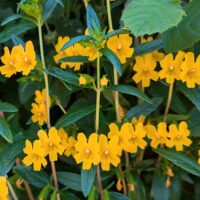
Sticky monkeyflower is the native monkeyflower species that brightens the hills and coast around Sonoma County. From spring through summer, its profuse yellow-orange tubular flowers decorate evergreen foliage reaching 2-4 feet tall and wide. An unbeatable habitat plant that is highly attractive to hummingbirds. Give it good drainage and keep on the dry side. Thrives in full sun near coast with light shade inland, and benefits from light annual trimming. A larval food source for the common checkerspot and buckeye butterflies. Deer resistant.
Diplacus (Mimulus) aurantiacus ‘Mattole Point’
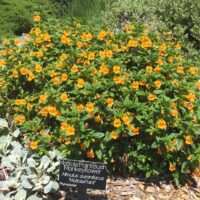
Found along the Lost Coast near the mouth of the Mattole River by Mark Moore of the Humboldt Botanic Garden, this fine selection of our native sticky monkeyflower has particularly beautiful evergreen foliage and a compact habit with glossy, dark-green, deeply veined leaves. The abundant orange, tubular flowers are tucked into the dense foliage which grows 2 ft. or so tall and wide. Plant in full sun on the coast to light shade inland and provide good drainage and occasional summer water. Hummingbirds and bees use the flowers and it is a larval food source for checkerspot and buckeye butterflies. Deer resistant.
Diplacus (Mimulus) aurantiacus ‘Russian Gulch’
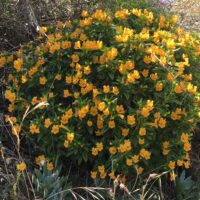
From the bluffs of the Sonoma Coast comes this beautifully compact form of sticky monkeyflower. The shiny, evergreen leaves are spaced to form a tight mound, 2 ft or so tall and wide. From late spring into autumn, cheerful, orange, tubular flowers cover the dense foliage. Makes a colorful, drought-tolerant addition to the garden where it can grow in full sun on the coast to part shade inland. Benefits from pinching to form a strong framework to support the flower display. Requires good drainage and responds to occasional watering, but resents drip irrigation systems that deliver water on a regular basis. Hummingbirds and bees relish the flowers and it is the larval food source for checkerspot and buckeye butterflies. Deer resistant.
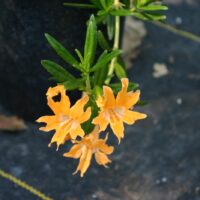
Diplacus (Mimulus) bifidus ‘Esselen’
We have been impressed with this fine selection from Big Sur, which offers compact habit, shiny green foliage and broad bright-orange flowers over a long period. Plant in sun to light shade with little to occasional summer water. Bees, butterflies and hummingbirds all work the flowers and it is a larval food source for the Checkerspot butterfly. Deer resistant.
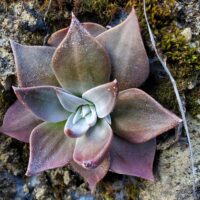
Dudleya cymosa
This charming succulent is in native to California where it grows in between rocks on inland cliffs in sun or bright shade. Best in the garden in a rock wall or terra-cotta pot with some afternoon shade. Height in flower is under one foot. The yellow to orange flowers are attractive to hummingbirds. Occasional to infrequent water in the ground. In pots, let dry out between waterings.

Epilobium ‘Bert’s Bluff’
A Las Pilitas Nursery selection, named for the founder, Bert Wilson. This California fuchsia sports grey foliage, growing 2 -3 foot tall and spreading. Blooming in late summer, the bright orange-red, tubular flowers are beloved by hummingbirds, but visited by bees as well. This cultivar is reputed as being particularly tolerant of a wide range of soil conditions and growing environments. Plant in full sun with occasional deep summer watering.
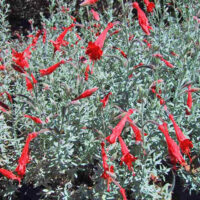
Epilobium ‘Roger’s U.C. Hybrid’
A California fuchsia that is upright in habit with narrow silver-gray foliage and slender trumpet-shaped blossoms of orange-red. Reaches a height of about 1 1/2 ft. and spreads easily. Very similar to the selections ‘Carman’s Gray’ and ‘Chaparral Silver’. Flowers best with occasional deep watering. Hummingbird favorite. Pruning plants down to a few inches in late autumn helps to rejuvenate them for the following year.
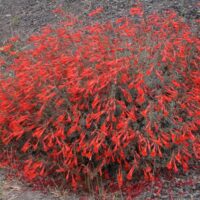
Epilobium ‘Schieffelin’s Choice’
This California fuchsia grows close to the ground - 10 - 12 inches tall with arching flower stalks. Gray foliage makes a wonderful foil for the bright orangey-red tubular flowers which appear summer through fall. Believed to be a cross between E. septentrionale and E. canum. Provide full sun to very light shade. One of the more drought tolerant selections but flowers best with occasional deep watering. Hummingbird favorite. Pruning plants down to a few inches in late autumn helps to rejuvenate them for the following year. Perhaps more deer resistant than other California fuchsias.
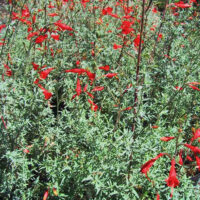
Epilobium canum ‘Bowman’s Hybrid’
This California fuchsia has distinctive narrow, olive-green foliage and an upright habit about 2-3 ft. tall and spreading widely. The orange-red tubular flowers are petite but profuse. Plant in sunny areas. Flowers best with occasional deep watering. Pruning plants down to a few inches in late autumn helps to rejuvinate them for the following year. Hummingbird favorite.
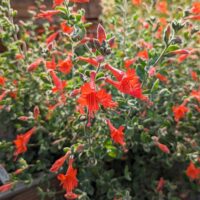
Epilobium canum ‘Calistoga’
Phil Van Soelen’s selection of California fuchsia from the Palisades east of Calistoga. Forms a spreading mat of unusually wide, fuzzy, gray leaves. The flowers are the typical hummingbird attracting orange-red trumpet shape and appear on stalks reaching up to 18 inches high. For sunny areas. Flowers best with occasional deep watering. Pruning plants down to a few inches in late autumn helps to rejuvenate them for the following year.
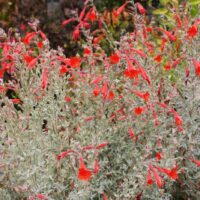
Epilobium canum ‘Carman’s Grey’
We love California fuchsias and have grown this cultivar for over twenty years. Valued for their beauty and important late season nectar source for hummingbirds, California fuchsias offer many forms and foliage colors. 'Carman's Grey' has gorgeous grey foliage which contrasts beautifully with the masses of orangey-red, tubular flowers, late summer and fall. The grey, narrow leaves form soft mounds 2 foot tall, spreading by underground rhizomes, 4 foot or so wide. Plant in full sun to very light shade where it is tolerant of many soil types, even heavy clay, drought tolerant, but best with occasional summer watering. Hummingbird magnet and bees use it too.
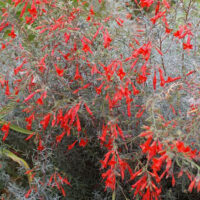
Epilobium canum ‘Catalina’
An outstanding selection of California fuchsia growing 3 ft. tall or more. This may be the tallest cultivar available, sometimes reaching as much as 5 ft. tall. The foliage is silvery-gray with an abundance of large, brilliant orangey-red tubular flowers late summer through fall. This species from southern California is particularly drought tolerant. Hummingbird favorite. Flowers best with occasional deep watering. Pruning plants down to a few inches in late autumn helps to rejuvenate them for the following year.
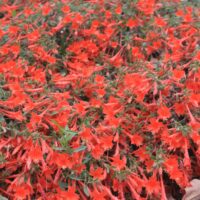
Epilobium canum ‘Cloverdale’
This form of California fuchsia was selected by U.C. Santa Cruz Arboretum from along the Russian River north of Cloverdale. Low, slightly mounding fuzzy olive-green foliage with an abundance of orangey-red tubular flowers the hummingbirds love. Usually stays bellow one ft. in height. 'Cloverdale' is one of the most orange selections of California fuchsia. Plant in full sun. Flowers best with occasional deep watering. Pruning plants down to a few inches in late autumn helps to rejuvenate them for the following year.
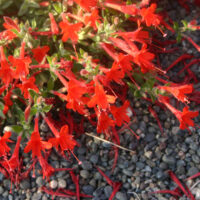
Epilobium canum ‘Everett’s Choice’
A low, spreading form of Californica fuchsia staying below one ft. in height. Distinctive for its fuzzy, gray-green foliage with many scarlet tubular flowers from summer through to fall. Good for sunny areas, though tolerates light shade. Flowers best with occasional deep watering. Attracts hummingbirds. Pruning plants down to a few inches in late autumn helps to rejuvenate them for the following year.