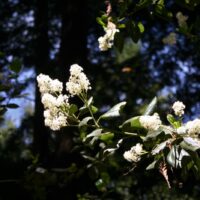
Ceanothus velutinus
Found primarily in the northern half of the state in the Coast Ranges, Sierras, Klamath and Modoc regions, in coniferous forests, chaparral, and various woodland environments up to 11,000 ft in elevation, the resinous floral scent and plumes of soft white flowers from spring to early summer make tobacco brush a choice evergreen shrub for dry, sunny to part-shade garden sites that drain well. Grows to 6-10 ft tall, and has large, sticky dark-green, aromatic, leathery foliage. A larval host for many native butterfly species such as the ceanothus silk moth, California tortoiseshell butterfly, and the hedgerow hairstreak butterfly. The flowers are also attractive to native bee and butterfly pollinators. Drought-tolerant once established.
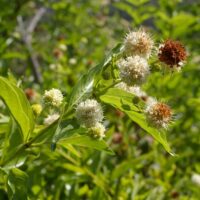
Cephalanthus occidentalis
Button willow is a large deciduous shrub, at times becoming treelike, growing 6-12 ft. (infrequently as much as 20 ft.) tall and wide. It lines waterways in foothills and warm interior valleys. Smooth, glossy bright- green leaves clothe this shrub during the growing season, turning yellow in the autumn. Creamy white flowers are arranged in spherical heads with protruding styles which give the flowers a pincushion-like appearance. The summer blooming, fragrant flowers are extremely rich in nectar and attract bees, butterflies and other pollinators. The globe-like fruits persists into winter and attract birds. Plant in sun to light shade with regular summer water or continuously moist or wet soils. An excellent habitat plant offering food and cover for a wide array of insects and birds.
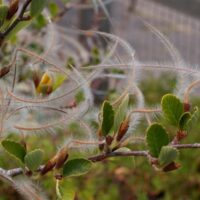
Cercocarpus betuloides
Mountain mahogany is an adaptable, semi-evergreen native shrub (8 to 12 ft. high and wide) or small tree with charming birch-like leaves set against silver-grey bark. Small, honey-scented flowers appear in spring followed by seeds with intriguing silky, curled, feather-like tails. The open habit contrasts nicely with evergreen shrubs or rock walls where its pleasing silhouette can be seen. Flowers are attractive to bees. Mountain mahogany is one of those rare native shrubs which can easily be pruned for narrow garden beds. Grows on dry slopes in chaparral or at the edges of woodlands. Provide full sun to light shade. It is surprisingly adaptable to diferent water regimes, from moderate irrigation to no water once established. Somewhat deer resistant.
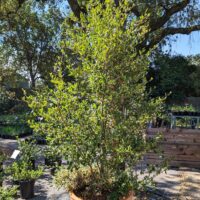
Cercocarpus betuloides var. blancheae
This rare and beautiful variety of our native mountain mahogany offers larger, birch-like leaves with fuzzy and whitish undersides. The highly useful from generally reaches 8 – 15 ft. tall, but only spreads to about 6 ft. wide, making it ideal for narrow locations where a screening, evergreen, fast-growing bush is needed. Small, disk-like, creamy flowers appear in the spring, followed in summer by seed pods with hairy, grey tails which curl upwards, giving the plant a silver halo. Over time, the trunks are covered in a smooth, grey bark. The Island mountain mahogany typically grows much more rapidly than our local variety and is tolerant of moist or dry soils once established and part shade to full sun. Heat isn’t an issue. A great candidate for a container, where it is very amenable to pruning.
Cercocarpus ledifolius
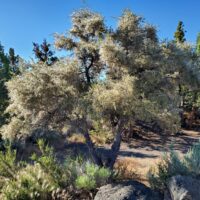
Large shrub or small, multitrunked, evergreen tree, 6 - 30 ft. tall, native to arid mountains of the western US. Often takes on a gnarled, picturesque form depending on the conditions it is growing in. Adapted to dry, rocky slopes where it weathers drought, extreme heat and cold, wind and snow. Slow growing, densely branching, with dark green, leathery leaves with curled under edges and silvery undersides. Trunks develop beautiful, red-brown bark with silvery new growth. The flowers are similar to our local mt. mahogany species, small, greenish- yellow, smelling of honey, and attractive to pollinators. The fruits are long, silvery, plumes that glow when back lit. Plant in full sun to light shade with good drainage where it will blend well with other dryland shrubs and perennials and requires little input. Fixes nitrogen. Interesting container or bonsai subject.
Cornus glabrata
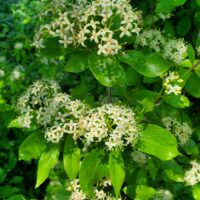
The bluish-white fruits of this species are reputed to be especially good for attracting birds. Small creamy white flowers appear in spring on subtly beautiful arching branches. A type of stream dogwood, it forms thickets with time, 6 - 10 ft. tall. Deciduous. Prefers moisture and some shade. Western tanager and warblers eat the flowers. Grosbeak, Northern oriole, flickers, spotted towhee, Western bluebird, robins, mockingbirds, bandtailed pigeon, waxwing and quail eat the fruits. A great plant for stream restoration.
Cornus sericea ‘Hedgerow’s Gold’
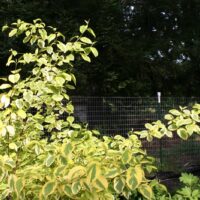
A striking selection of redtwig dogwood, discovered near the Deschutes River in Eastern Oregon and introduced by Hedgerows Nursery. The large leaves of soft green have a broad, irregular, bright golden edge. In autumn the leaves turn an attractive ruby color. Forms a thicket that easily reaches 6 ft. tall by 6 ft. wide. The red stems stand out in the winter landscape after the leaves have fallen. Flat topped cluster of white flowers appear in spring and are followed by small white fruits enjoyed by birds. Best with regular water, good light and protection from the hot afternoon sun.
Cornus sericea ssp. occidentalis ‘Tomales Bay’
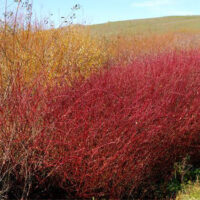
This selection of the native creek dogwood is from Tomales Bay, Marin County, where it forms broad clumps 6 ft. or more tall and wide. The beautiful red stems stand out in the winter landscape. Flat topped flower clusters are creamy white followed by small white fruits. Good fall color. Plant in full sun to light shade and give regular irrigation. Western tanager and warblers eat the flowers. Grosbeak, Northern oriole, flickers, spotted towhee, Western bluebird, robins, mockingbirds, bandtailed pigeon, waxwing and quail eat the fruits.
Corylus cornuta ssp. californica
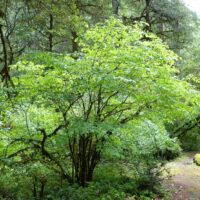
Western hazelnut is a handsome, open, multi-stemmed shrub native to forests from Santa Cruz northwards in the Coast Range, and from Sequoia northwards in the Sierra foothills. Winter deciduous with decorative dangling catkins in winter. The soft, somewhat hairy leaves turn yellow in the fall. Small amounts of tasty nuts are produced in late summer and are relished by wildlife and people. Part shade with some moisture, but will tolerate fairly dry conditions once established. Usually grows 6 - 10 ft. tall. Somewhat deer resistant.
Frangula (Rhamnus) californica – large, inland form
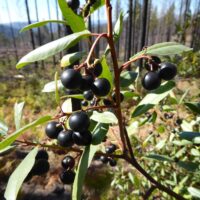
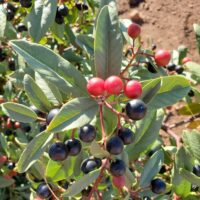
Handsome native evergreen shrub with small greenish-yellow flowers followed by showy dark-colored berries. The propagation material for this this crop was collected from tall, upright shrubs on a hot inland site. Growing 8 ft. or more tall, coffeeberries thrive in full sun to light shade. They are drought tolerant once established, but would appreciate occasional deep summer waterings. A good choice for hedgerows and habitat gardens, coffeeberry provides food and nectar for a wide array of beneficial insects, birds and wildlife.
Frangula (Rhamnus) californica ‘Eve Case’
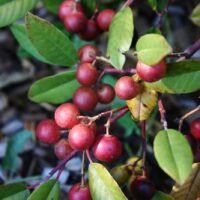
This well-known cultivar of coffeeberry was introduced to the trade in 1975 by the Saratoga Horticultural Foundation. Coffeeberry is a handsome evergreen shrub with broad leathery leaves. This selection grows to 6 ft. tall and wide, though mature specimens can reach 8 ft. or more tall under ideal circumstances. The small yellow-green flowers are not showy but attract an array of pollinators. The berries start out green and age to burgundy-black and are attractive to small mammals and birds. A larval food source for pale swallowtail butterfly. Adaptable, grows in sun to light shade. Drought tolerant but appreciates occasional summer water.
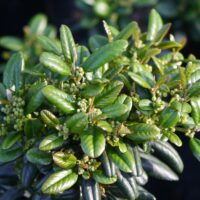
Frangula (Rhamnus) californica ‘Leatherleaf’
Another fine Roger Raiche selection, this coffeeberry cultivar is well worth growing. The evergreen leaves are particularly dark and broad with a mounding habit growing 5 - 6 ft. tall and wide. The tiny flowers attract a wide array of pollinators. Larval food source for pale swallowtail butterfly. The handsome fruits go green to red to black and are enjoyed by small mammals and birds. Plant in sun to light shade. Drought tolerant once established though occasional summer watering is helpful. An adaptable and useful shrub for both formal and naturalistic plantings.
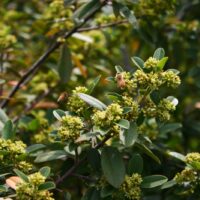
Frangula (Rhamnus) californica ‘Mound San Bruno’
Selected by Roger Raiche on San Bruno Mountain in San Mateo County, this is one of the most reliable coffeeberries. Grows 6 ft tall and wide, with narrow, evergreen leaves and a compact habit. For full sun on the coast to part shade inland. Will tolerate irrigation, but needs only occasional summer water once established. Flowers are loved by pollinators, especially bees. A larval food source for the pale swallowtail butterfly. Provides black juicy fruit in the fall for thrushes, jays, mockingbirds, and robins. May grow to as much as 8 ft. tall with moderate water and good drainage in cooler areas.
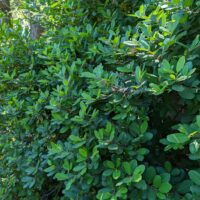
Frangula (Rhamnus) californica ‘Olema’
We discovered this large, dense form of our native coffeeberry near the town of Olema in coastal Marin County. While it reached up to around 15 ft. tall and wide in nature, it has been a little slow to do so in the ground here at the nursery. After about 4 years, it’s reached a height of about 9 ft. This selection of coffeeberry is ideal for a tall hedge or screen where an evergreen shrub is needed to create privacy. Grows well in full sun somewhat near the coast but will need a little shade in hot, inland sites. Occasional to infrequent irrigation once established. Coffeeberries are some of the best habitat plants. The small, yellowish flowers are adored by bees in spring and summer, while the plump, purple fruits that follow are relished by birds.
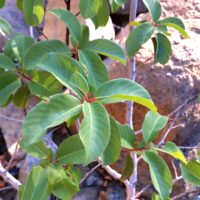
Frangula (Rhamnus) californica ssp. occidentalis
Description coming soon!
Frangula (Rhamnus) californica ssp. tomentella
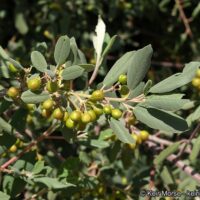
This distinctive species of coffeeberry features blue-grey leaves with velvety, silver undersides and grey, fuzzy stems. The somewhat open form grows 6 to 10 ft tall and wide. Clusters of small cream-colored flowers appear from winter through spring and are a favorite of bees. The deep purple fruits which follow are highly prized by birds. While native to serpentine soils, this coffeeberry should thrive anywhere with decent drainage. Provide full sun to light shade and give occasional irrigation once established. The grey stems contrast beautifully with the shiny, dark green leaves of Ceanothus ‘Yankee Point’.
Fremontodendron ‘Ken Taylor’
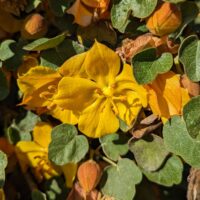
Showy native shrub for sunny, dry areas. This form of flannel bush only grows 4 - 6 ft. tall and 10 ft. (or more) wide but can be pruned to be kept narrower. Beautiful cup-shaped golden yellow flowers with orange backs bloom in late spring and into summer. Highly attractive to bees and other pollinators. An excellent nectar plant for orioles. Once established, this selection of flannel bush is completely drought tolerant and will accept infrequent summer water only where drainage is excellent.
Fremontodendron ‘Pacific Sunset’
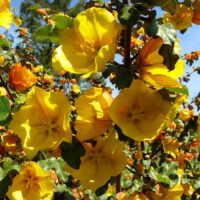
This showy hybrid flannel bush grows in a broad “V” shape to 20 ft. tall. Covered with large orange-yellow cup-shaped flowers for a long period in spring. The large flowers attract bees and other pollinators. An excellent nectar plant for orioles. Requires full sun and plenty of room. Best if not watered once established. Needs decent drainage

Fremontodendron ‘San Gabriel’
Large, showy, hybrid flannel bush quickly growing to 20 ft. tall. Covered with buttercup yellow blossoms in the spring. Because of the nature of their branching, ‘San Gabriel’ and ‘Pacific Sunset’ both espalier well. An excellent nectar plant for orioles. Requires full sun. No summer water once established. Needs decent drainage.
Fremontodendron californicum
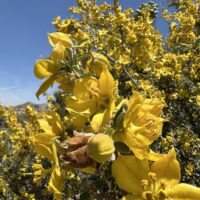
In late spring, this evergreen shrub makes for a stunning display along dry foothill slopes. As masses of bright yellow blooms cover its stems, its leathery, fuzzy leaves all but disappear among the showy, cupped flowers. Of the three Fremontodendron species, all native to California, this flannel bush has the widest distribution, mostly in the western Sierra foothills and Southern California. Its range is limited to sites with well-draining, sandy or rocky soil, and it can be sensitive to garden irrigation and heavy soils. Best planted in full sun with similarly low-water species where it receives minimal direct water once established. When happy, it is fast-growing to 15 or more feet, making it a good all-season hedge. Flowers are wildly popular with bees and other pollinators.
Garrya elliptica
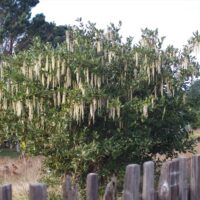
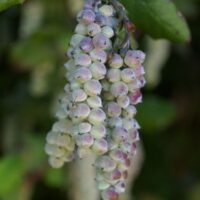
Garryas are grown primarily for their winter flower catkins. The longer, pendulous male catkins have traditionally been the most sought after with selections like 'James Roof' and 'Evie'. Male and female flowers occur on separate plants and both must be present for the female to produce their lovely grapelike clusters of fruit. These plants are seed grown so males and females are of equal probability. All plants feature larger, evergreen leaves on multitrunked shrubs reaching 10 - 15 ft tall and wide. Very amenable to pruning. Plant in full sun or partial shade. Provide moderate irrigation inland, but established plants will be drought tolerant near the coast where they occur naturally. Somewhat deer resistant.
Garrya elliptica ‘Evie’
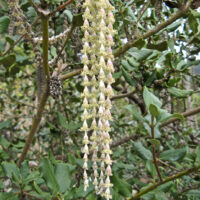
This cultivar of the native silktassel bush is more compact than the better known ‘James Roof’. The 8 to 10 inch catkins are shorter but more profuse. Evergreen, grows 10 ft. or taller. Sun to part shade, good drainage. Provide moderate to occasional irrigation inland. Winter is its showiest time when it is covered in silvery catkins. Discovered on the northern Sonoma Coast. Somewhat deer resistant.
Garrya elliptica ‘James Roof’
Outstanding cultivar of the native silktassel bush. Evergreen shrub 10 ft. tall or more. Striking 12 inch long silvery catkins in winter. Sun to part shade and drought tolerant. Enjoys moderate summer water inland. Discovered along the coast of Prairie Creek State Park in Humboldt Co.. Somewhat deer resistant.
Garrya fremontii
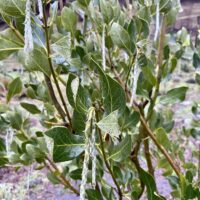
Evergreen shrub with leathery leaves and handsome dangling catkins in late winter and early spring. The male and female flowers occur on separate plants. Native to the west coast where it grows in mixed evergreen forest and chaparral plant communities. This species is a good choice for summer-hot interior sites with well drained soils. Grows 8 - 10 ft. tall and wide in full sun to light shade and is drought tolerant once established. A good specimen shrub or candidate for hedgerow or screen where it provides cover and food for birds and small mammals. Somewhat deer resistant.
Garrya issaquahensis ‘Pat Ballard’
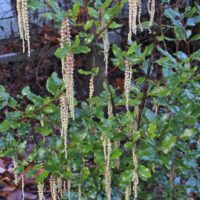
An elegant winter flowering shrub, uncommon in the trade. A hybrid between Garrya elliptica and Garrya fremontii, 'Pat Ballard' is a tough evergreen growing 6-10 foot tall and wide. Pendulous pinkish gray catkins dangle from the branch tips in winter providing a spectacular display. Plant in full sun to part shade with occasional to infrequent water once established. More cold & drought tolerant than Garrya elliptica. An excellent screen, hedge or foundation shrub, amenable to pruning. Somewhat deer resistant.
Hesperocyparis macnabiana
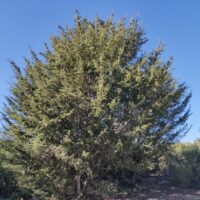
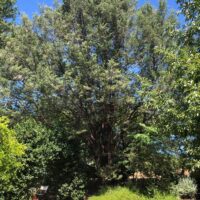
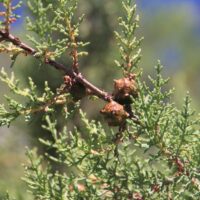
MacNab Cypress is native to dry, open, slopes, usually on serpentine, in chaparral and woodlands of Northern California. Fast growing tree or large shrub, 15 – 40 ft. tall, often with multiple trunks and a spreading crown, growing wider than it is tall. The pleasantly pungent, grey-green, foliage smells like gin and is arranged on flattened branches, giving it a somewhat lacey appearance. The bark is rough and furrowed and the cones are spherical and persistent. Plant in full sun with good drainage and little to no summer water once established. Deer resistant.