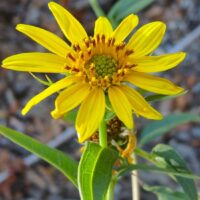
Helianthus californicus
This giant, perennial sunflower is native to riparian habitats in openings with decent light. Dormant in the winter, spring brings rapid growth, with narrow, bright green leaves on tall stalks rising 7 feet or more above a root system which spreads widely. Summer brings many small, golden-yellow sunflowers on the branch tips which are quite dramatic in full bloom. Flowers attract bees and butterflies and the seeds are relished by birds. Perfect for stabilizing soil where there is some summer water and plenty of space. Once established it can take it dryish, but will flower better with water. An excellent cut flower.
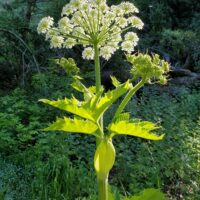
Heracleum maximum
Big, bold, native perennial 3 - 8 ft. tall, is striking in mass or as a specimen. Forms a rosette of large lobed leaves followed by stout flower stems carrying large umbels of white flowers. Thrives in rich soils with some moisture. Full sun along coast, part shade inland. As a member of the carrot family (Apiaceae) the flowers are very effective at attracting beneficial insects. Larval food source for anise swallowtail butterfly. Formerly known as Heracleum lanatum.
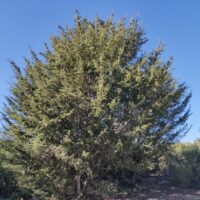
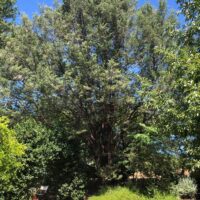
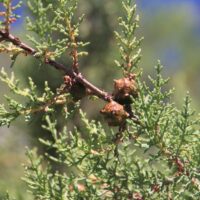
Hesperocyparis macnabiana
MacNab Cypress is native to dry, open, slopes, usually on serpentine, in chaparral and woodlands of Northern California. Fast growing tree or large shrub, 15 – 40 ft. tall, often with multiple trunks and a spreading crown, growing wider than it is tall. The pleasantly pungent, grey-green, foliage smells like gin and is arranged on flattened branches, giving it a somewhat lacey appearance. The bark is rough and furrowed and the cones are spherical and persistent. Plant in full sun with good drainage and little to no summer water once established. Deer resistant.
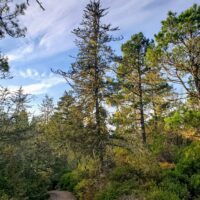
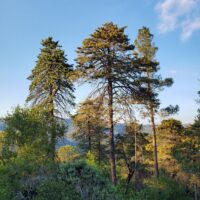
Hesperocyparis sargentii
This cypress makes its home in serpentine pygmy forests from Santa Barbara to Mendocino Counties. While often dwarfed in its native terrain, this species can grow quite happily off of serpentine and may reach up to 60 ft. tall. The small, dark-green, scale-like leaves form a bushy canopy against the gray-brown trunk. A good medium-sized tree for hotter inland areas, but will also tolerate coastal conditions. The sargent cypress can grow fairly rapidly, useful as a high privacy screen or wind break. Plant in full sun to light shade and water occasionally. Will be very drought tolerant once established. Needs good drainage. Deer resistant.
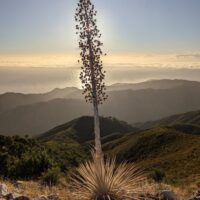
Hesperoyucca whipplei
Bold and dramatic architectural accent plant native to southern California coast and mountains south to Baja. Forms a dense rosette of rigid silver-blue blades, 2 foot tall by 3 - 4 foot wide. Each blade has a VERY SHARP tip and careful thought should be given to its placement to avoid injury. Plants can take 3 to 15 years to bloom with impressive stalks rising 6 foot or more above the rosette with drooping, creamy white, bell shaped, fragrant flowers. The flowering rosette dies after blooming often being replaced by vegetative offsets. Best with good drainage in full sun to light shade. No water once established. Deer resistant
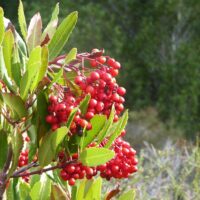
Heteromeles arbutifolia
Toyon is a handsome native evergreen shrub 6 - 10 ft. tall and wide. Sun to part shade, drought tolerant. Clusters of lacy white flowers bloom in summer and areattractive to pollinators. Spectacular bundles of red berries are relished by birds and are a great winter decoration. Valuable as a specimen, screen, hedge or bank plant. Birds attracted to the fruit include the following species: Cedar waxwing, California towhee, spotted towhee, Western bluebird, robins, mockingbirds, bandtailed pigeon, waxwing and quail.
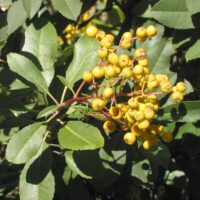
Heteromeles arbutifolia ‘Davis Gold’
An interesting cultivar of the native toyon which bears bright golden yellow berries rather than the more common red-colored fruits. A handsome evergreen shrub 8 - 12 ft. tall and wide (or more). Sun to part shade, drought tolerant. Clusters of lacy white flowers bloom in summer and are attractive to pollinators. The showy clusters of orange-yellow berries are relished by birds and are great winter decoration. Valuable as a specimen, screen, hedge or bank plant. This selection is considered more disease resistant than most toyon.
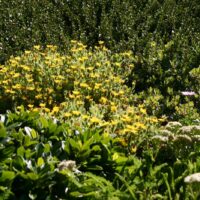
Heterotheca sessiliflora ssp. bolanderi ‘San Bruno Mountain’
Versatile and tough native perennial well suited for the rock garden front of the border or container plantings. Evergreen foliage forms low mats topped with bright yellow daisies in summer - fall. For sunny sites and dryish conditions. Flowers are appealing to bees and butterflies.
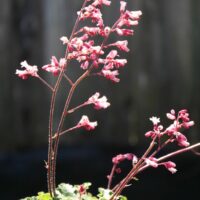
Heuchera ‘Canyon Duet’
A Santa Barbara Botanic Garden selection, part of their Quartet Series of hybrids. This charming, diminutive coral bells forms low, sturdy clumps of small rounded leaves slowly spreading to about 10-12 inches wide. Bi-colored flowers of dark pink and white rise 12 to 18 inches above the dense foliage in spring and early summer. Heuchera's require good light to bloom well but resent full sun, especially inland. Moderate to occasional water. Excellent small scale perennial for mixed border, edging or rock garden. Good container subject too.
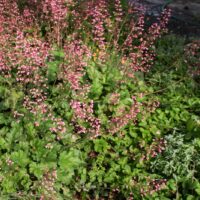
Heuchera ‘Old La Rochette’
Here is a wonderful, often hard to find Heuchera hybrid. Grows into robust clumps of rounded leaves to around 1 ft. tall and 1 - 2 ft. wide. 2 ft. tall flower stalks carry hundreds of soft pink blossoms in the spring, and often intermittently through the summer. Sturdy perennial for part shade and a little summer water. This species attracts hummingbirds.
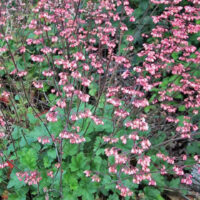
Heuchera ‘Rosada’
Listed as one of U.C. Davis Arboretum’s “All Stars”, this heuchera hybrid is tough and dependable. Forms an attractive mound of evergreen foliage 10 - 12 inches tall. A long display of tall flower stems covered with creamy-pink dainty bells begin in the spring and often continue into the summer. Best with part shade and moderate to occasional summer water. Attracts hummingbirds.

Heuchera ‘Santa Ana Cardinal’
An outstanding hybrid that is vigorous and free flowering. Compact clumps of foliage topped with 2 ft. tall flowering stems with vibrant rose-red blossoms over a long period. Plant in cool full sun to light shade with moderate to occassional summer water once established. This species attracts hummingbirds.
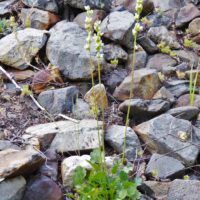
Heuchera cylindrica
Native to the northern mountains of California, the roundleaf alumroot is distinctive for its dense clusters of white to cream-yellow flowers held on vertical stems reaching 1 to 2 ft tall. Round leaves grow in tight mounds up to 8 inches high and 2 ft wide. Combine with pink Heucheras, Iris and small ferns for an attractive woodland display. Needs part shade and decent drainage. Attracts hummingbirds. Drought tolerant.
Heuchera hirsutissima
This miniature alumroot is the perfect addition to the lightly shaded rock garden or along the edge of a path. Pinkish-white, dainty flowers sit atop short stems only about 4 inches tall in spring and summer. The little 2 inch mounds of dark green leaves slowly spread to form tiny drifts. Provide good drainage and moderate irrigation. An excellent plant for a rock crevice or container where it can be combined with Idaho fescue, Erigeron 'Olga' or leather fern. This species comes from the San Jacinto and Santa Rosa mountains of southern California.
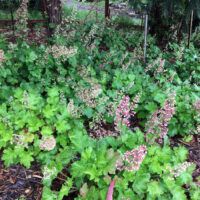
Heuchera maxima
Native to the Channel Islands, this is one of the most adaptable and vigorous of the alum roots, forming broad evergreen mounds of bright green folilage 1 - 1 1/2 ft. high. Maroon flower stems are 3 ft. high topped with pink blushed creamy flowers that have a slight green haze. Best with part shade and a little summer water, but will tolerate full sun close to the coast. Good for use under oaks. This species attracts hummingbirds.
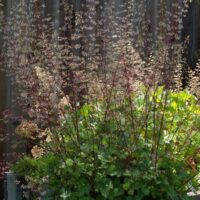
Heuchera micrantha
This is our common alum root which is usually seen on shady cliffs and roadbanks adjacent to forests. Easy to grow in garden situations. Forms low mounds of foliage topped with dainty white flowers on long stems. Likes moisture, but tolerates considerable drought and takes deeper shade than most Heuchera species. This species attracts hummingbirds.
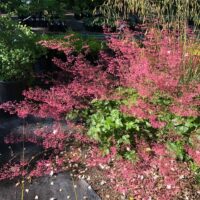
Heuchera micrantha ‘Martha Roderick’
Here’s a pink flowered form of the normally white flowered native alum root. Foliage forms handsome clumps topped with slender stalks 1 - 1 1/2 ft. tall of tiny pink flowers. Excellent in woodland setting for border, slope or rock garden. Drought tolerant but best with a little water. This species attracts hummingbirds.
Heuchera pilosissima
Native to the coast from Mendocino to Santa Barbara Counties, this perennial forms compact, evergreen clumps of light-green scalloped leaves. Stocky flower stems 12 – 16 inches long carry small white-pink flowers in early summer. Perfect in coastal areas where it can grow in sun to light shade and will be drought tolerant once established. Must have part shade and some summer water inland. Plant in mass for a nice ground cover in a woodland setting or in mixed plantings with shrubs and ferns. Attracts hummingbirds.
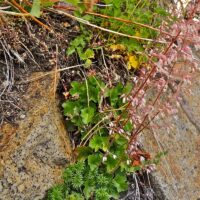
Heuchera rubescens
The pink alumroot stands out with bell-like flowers of pink and white held in clusters on slender stems up to 1 ft tall. The round, scalloped leaves form low, dense mats up to 1 1/2 ft wide and about 6 inches high. This western mountain dweller looks beautiful in a rock garden but will do well in any situation with part shade and good drainage. Needs moderate to occasional irrigation once established. Attracts hummingbirds. Great in a container.
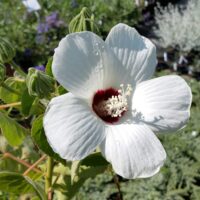
Hibiscus lasiocarpos var. occidentalis (californicus)
A rare species from wetland habitats in the Delta of the Central Valley, which are seriously threatened due to habitat disturbance and development. A large perennial growing 3 - 6 ft. tall with heart-shaped fuzzy leaves on sturdy stems and large showy white flowers with deep pink centers in the summer. Tropical looking and water loving this interesting herbaceous perennial grows best with summer heat. Plant in full sun to light shade with regular water. Tolerates heavy soils and seasonal flooding. Nice container specimen where its needs may be easier to meet.
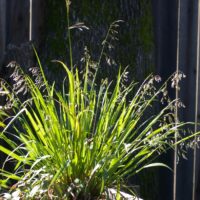
Hierochloe (Anthoxanthum) occidentalis
Here is an interesting and elegant grass native to coniferous forests. Broad, bright green, sweetly scented blades grow a foot or more tall. Flowering culms rise another 6 inches or so above the foliage with tight panicles of spikelets. The leaves offer a sweet, vanilla fragrance when dried. Excellent for woodland gardens, compatible with many redwood forest plants. Best with some summer water, but is drought tolerant near the coast. A larval host for the Western branded skipper butterfly. Deer resistant.
Hierochloe (Anthoxanthum) odorata
Invite good spirits into your home and garden with this interesting, fragrant grass. Sweet grass is an aromatic, native perennial, with an extensive range in the United States, Canada and Eurasia. Growing in wetlands, prairies and meadows, it prefers rich, moist, soils and at least half day of sun. The grass flowers sit just above the foliage where they can dance with the wind. This cool season grass is sacred to indigenous people, where it is used in herbal medicine, a kind of tobacco, basket making, and burned as a smudge. Growing 1 - 2 ft. tall and spreading widely by sturdy rhizomes that can be difficult to eliminate once well established. Winter dormant in cold areas. Deer resistant.
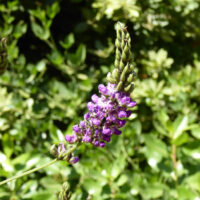
Hoita macrostachya
Leather root is a robust perennial, native to California’s coastal and inland valleys. It forms dense clumps of trailing or ascending stems with trifoliate leaves and showy clusters of purple-to-lavender, pea-like flowers that bloom from late spring through summer. It thrives in full sun to light shade, and prefers well-drained soils, though it tolerates clay. While somewhat drought tolerant, it enjoys deep summer irrigation. This species is ideal for slope stabilization and habitat restoration. It attracts bees and butterflies while fixing nitrogen in the soil, creating a resilient, ecologically-supportive landscape.
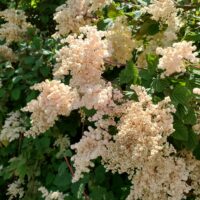
Holodiscus discolor
An elegant, deciduous, native shrub growing 5 - 6 ft. tall or more, depending on the site, and at least as wide. Beautiful, cascading clusters of creamy white flowers hang from branch tips in early summer. The fragrant flowers attract pollinators and a number of butterflies use it as a host plant. Best with light shade. Drought tolerant, but will accept some moisture.
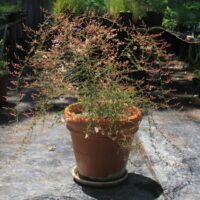
Holodiscus dumosus ‘var. cedrorus’
A recently described endemic shrub discovered by the extraordinary plantsmen Roger Raiche, growing on serpentine soils of the Cedars in northwestern Sonoma County. An open deciduous shrub, approximately 3 ft. x 3 ft. with wiry ruby-red stems and elegant small, shiny, dark green to bronze leaves. Early summer brings erect panicles of cream colored flowers that are suffused in light wine-red or pink coloration. Seems to tolerate a wide range of conditions from full sun to deep shade. Once established has proven durable and drought tolerant. This lovely small creambush is perfect for those who want something completely new and different. It does well in containers and should be interesting to experiment with in different applications and settings.
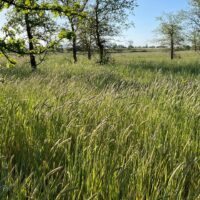
Hordeum brachyantherum
Native to a wide range of vernally wet plant communities throughout California and beyond. Once abundant throughout the Santa Rosa Valley where it could be found in grasslands, seasonal flood plains, moist meadow and open riparian areas. Forms perennial clumps with blades 6-10 inches tall, flower stalks to 30 inches are topped with narrow spikes of purple tinged upward facing bristles, looking like a small version of a classic cereal grain seedhead. Tolerant of heavy clay, alkaline or saline soils. Doesn't make a big impact standing alone, best used in mass or in a blend of other native meadow grasses where its slender flower heads make a pleasing effect. Plant in full sun with vernally wet soils. Deer resistant.
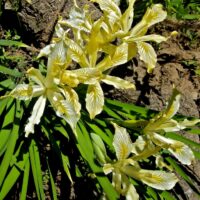
Iris chrysophylla
Native to far northern California and into western Oregon, this uncommon iris grows in fast draining soils in open forests and woodlands. A small scale iris, usually under 12 inches tall in bloom, spreads slowly from slender rhizomes. The delicate blossoms flower in the spring and can vary in color from white to cream to yellow, with a central yellow splash and prominent dark venation. Grow in sun to light shade with occasional to little watering. Visited by bees and hummingbirds. Deer resistant.