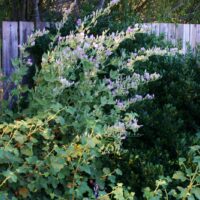
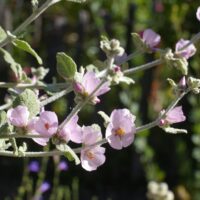
Malacothamnus fremontii
A fast growing, thicket forming, native shrub with silvery white, felted foliage 4 - 6 ft. tall and spreading. A profusion of pale-pink, cup-shaped flowers decorate the branch tips in summer. A tough and adaptable shrub for sunny dry areas, appreciating occasional summer water once established. Useful on banks or other challenging sites. Host plant for the Painted Lady and West Coast Lady butterfly. An excellent nectar source for orioles. Deer often seem to leave it alone.

Malacothamnus jonesii
A rare endemic from southern Monterey and San Luis Obispo counties, growing in foothill woodland and chaparral plant communities. Fast growing shrub, often coming in after fires or disturbance. Growing 4 - 6 ft. tall and wide with beautiful gray foliage, covered in white, velvety hairs. Lovely, soft pink, cup-shaped flowers appear in profusion on the slender branch tips, late spring into summer. Nectar is highly attractive to a myriad of insects, hummingbirds (who seek both nectar and insects), bees and butterflies. Larval food source for the West Coast Lady and Northern White Skipper butterflies. Plant in full sun to ight shade, where it will be drought tolerant once established.
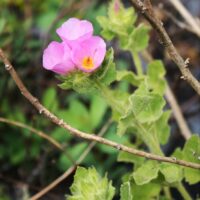
Malacothamnus palmeri var. lucianus
From the hot valleys of the Santa Lucia mountains in central California comes this rare form of the native bush-mallow. Deep pink, cup-shaped flowers appear in late spring and early summer above the fuzzy, light green leaves. Reaches a height of about 6 ft and slowly spreads to form colonies. Give full sun to light shade and provide little to no water once established. A good choice for hot, dry banks with Toyon, Ceanothus and Manzanita. An excellent nectar source for orioles. Deer seem to leave it alone.
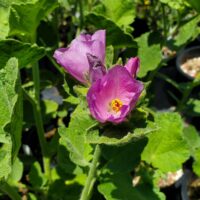
Malacothamnus palmeri var. lucianus ‘Hanging Valley’
Description coming soon!
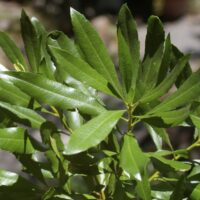
Morella (Myrica) californica
Native evergreen shrub with clean looking shiny foliage 15 ft. or more tall. Useful screen, clipped or informal hedge or even trained as multi-trunked small tree. An adaptable plant for sun to light shade, with moderate to occasional water. Its waxy berries attract flickers, robins and finches. Fairly deer resistant.
Myrica hartwegii
From Sierran streambanks comes this sweet bay, a cousin of our local wax myrtle. Rare in nature, this deciduous shrub can reach a height and width of up to 5 ft. Soft, lance-shaped leaves of gray-green flank the stems. Small red flowers appear in the spring. Enjoys dappled shade and good drainage. Requires regular irrigation. Plant with indian rhubarb, western columbine and ferns for a taste of the mountains in your own garden. Thought to be deer resistant.
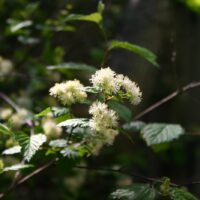
Neviusia cliftonii
Shasta snow-wreath is a rare species not know to science until 1992. Endemic to Shasta County, California, often on limestone embankments, in moist shady areas, this deciduous shrub grows to around 6 ft. tall spreading by underground rootstocks. Looking something like ocean spray or a delicate ninebark, heart shaped leaves with toothed edges are alternately arranged on the slender branches. The flowers are a starburst of white anthers in early spring surrounded by green petal-like sepals. A lovely addition to a woodland planting where it thrives in light shade with some summer water.
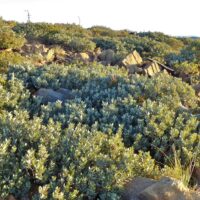
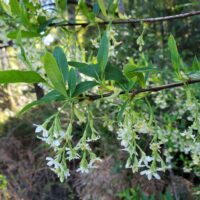
Oemleria cerasiformis
A charming native shrub which grows in moist areas along the coast or when inland on forest edges. Blooms in early spring just as the new leaves are beginning to expand with drooping clusters of fragrant white flowers. Male and female plants are separate and you'll need both to get the small blue-black fruits that birds enjoy. A suckering shrub growing 5 - 6 ft. tall or more. Plant in part shade with regular to occasional water. Can grow in cool full sun such as you find along the coast.
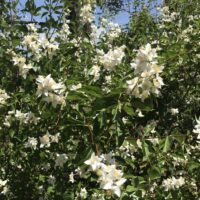
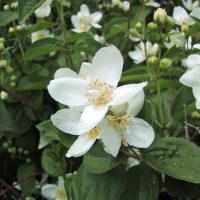
Philadelphus lewisii ‘Covelo’
Sweetly fragrant, pure white blossoms with yellow stamens cover this desirable, deciduous native shrub in late spring, attracting bees and butterflies. Reaches to 8 ft. tall and wide with a vaguely umbrella shape. This selection is somewhat denser than 'Marjorie Schmidt', in both foliage and flower, with leaves that are less serrated. Enjoys full sun to light shade and moderate to occasional summer water. Tolerant of clay soil. Works well in a conatainer.
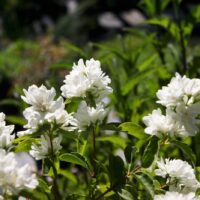
Philadelphus lewisii ‘Goose Creek’
This unusual selection of our native mock orange offers fully double flowers! We aren't usually fans of extra petals on our flowers, but this selection is quite appealing, with blossoms looking like fluffy snowballs held along the stems in late spring. This form was discovered near the Smith River in Del Norte County. Mock orange is a large deciduous shrub up to 8 ft tall and wide with sweetly fragrant, white flowers in late spring and early summer. Useful as a specimen or in mixed plantings. Sun to light shade, moderate to little water when established. A good container plant and clay tolerant.
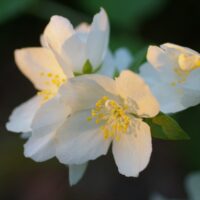
Philadelphus lewisii ‘Marjorie Schmidt’
This native mock orange was selected by Roger Raiche and Ron Lutsko in Shasta County. It caught their eye while driving along Route 36 west of Red Bluff, as being larger-flowered and more floriferous than surrounding shrubs. Large deciduous shrub up to 8 ft tall and wide with fragrant white flowers in early summer. Sun to light shade, most soils, moderate to little water once established. Flowers attractive to bees and butterflies.
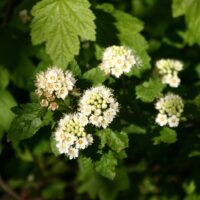
Physocarpus capitatus
Handsome, deciduous shrub favoring wooded streamsides in California. Grows vigorously 4 - 8 ft. tall and wide. After leafing out in the spring, the shrub looks spiraea-like, covered with small clusters of white flowers followed by red capsular fruits. Best with light shade and some summer water, but will accept full sun in cooler areas. Keep bushy and in bounds with pruning.
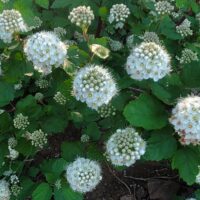
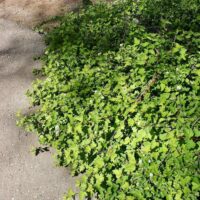
Physocarpus capitatus ‘Tilden Park’
A rare and delightful prostrate form of the native ninebark from San Bruno Mountain. Makes a sturdy groundcover about 3 ft. tall and spreading to at least 6 ft. wide, featuring lush, bright green, maple-like leaves with white flower clusters in the spring. The blossoms give way to bright red seed pods in the summer. Sun to light shade with moderate water, but will tolerate dryish conditions in part shade once established. Clay tolerant.
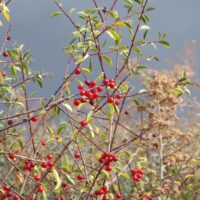
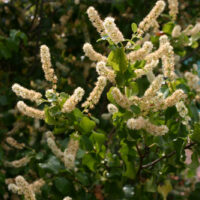
Prunus ilicifolia ssp. ilicifolia
Hollyleaf cherry is a large, evergreen shrub that can grow more than 15 feet tall and wide, but is easily pruned to be more compact. This adaptable foothill native can be clipped into a formal hedge, pruned to be treelike, or left to its own natural gumdrop-shaped habit. Often it is used for background or screen plantings. Glossy, holly-like leaves are accompanied by showy displays of creamy-white flowers in narrow spikes from late spring to early summer. Plant in full sun to very light shade. Looks best with occasional deep waterings, but can tolerate very dry conditions once established. Although it requires good drainage, it is tolerant of heat, drought, wind and oak root fungus. An excellent habitat plant, offering food and cover for wildlife. Birds enjoy the small reddish-purple cherries. Generally deer resistant.
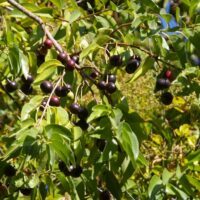
Prunus ilicifolia ssp. lyonii
This subspecies of our native cherry comes from Southern California and can be grown as a large shrub or trained into a small tree. The Catalina cherry is evergreen, with soft, glossy leaves and without the toothed leaf margin of our more local hollyleaf cherry. Gorgeous, creamy-white flower clusters make a showy display in spring. The purple-red fruits are edible, but are mostly preferred by wildlife. At 20-40 feet in height and slightly narrower in width, it is also larger than the hollyleaf cherry, but can be pruned to 8-10 feet. Its dense foliage makes an excellent hedge. Does best in well-drained soil with occasional deep watering once established. The flowers are adored by pollinators. Black-headed Grosbeaks, Cedar Waxings, Western Tanagers, and many other bird species love the cherries, which offer an excellent fall-migration food source.
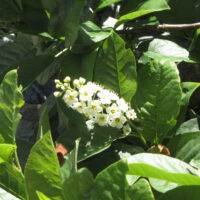
Prunus virginiana v. demissa
Large, deciduous shrub or small tree with red-purple bark and dark green foliage. Growing 8 foot or more tall and spreading slowly to form a thicket. Striking racemes of fragrant white flowers in the spring followed by dark red fruits which can be sweet but astringent. Foliage can take on nice fall color before dropping its leaves. Fabulous habitat plant drawing bees, butterflies and other pollinators to its flowers. Birds, especially bluebirds, adore the fruits and are known to swoop in and finish them off quickly. Where summers are hot, light or part shade is best, with regular to occasional water once established. They often grow where there is seasonal moisture in the spring, but somewhat dry as the season progresses.
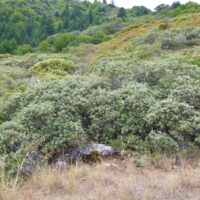
Rhamnus crocea
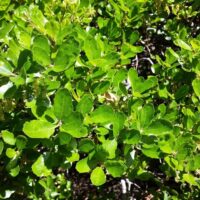
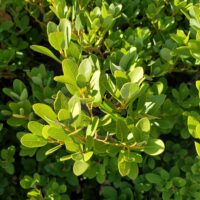
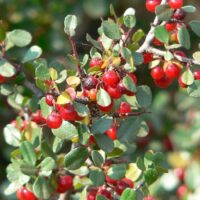
An under-used evergreen shrub native to chaparral, woodland, and coastal-sage scrub communities in California. Spiny redberry can grow up to 6 feet tall and wider, but is typically in the 2 - 4 ft. height range, spreading to 6 ft. or more across. Small, leathery, dark-green ovate leaves give this tough shrub a delicate look once established. The flowers on both male and female plants are inconspicuous, blooming from late winter into early spring. Female plants produce sporadic, jelly-like red berries. Great for dappled light under oaks, or a dry, shady woodland slope with California fescue. Can tolerate more sun near the coast, but prefers afternoon shade inland. Drought-tolerant once established. Larval host for a multitude of butterflies and moths, including the pale tiger swallowtail butterfly, Ceanothus silk moth, and Hermes copper butterfly. Deer resistant.
Rhamnus ilicifolia
A handsome evergreen shrub with small, dark green, leathery, serrated leaves. Found in the foothills and mountains of southern and central California, the Sierras and west of the Sacramento Valley up to 3,500 feet. Slow-growing, reaching 6-10 feet tall and wide, with a somewhat open, upright habit. Male and female plants are separate, producing inconspicuous yellow-cream flowers from spring into early summer. Female plants produce sporadic, gelatinous red fruits. Hollyleaf redberry can be planted in full sun to shade, but prefers a bit of relief from the afternoon sun in inland sites. It requires decent drainage and is drought-tolerant once established. Larval host for the pale swallowtail butterfly. Reportedly deer resistant.
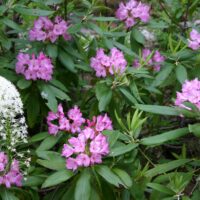
Rhododendron macrophyllum
One of the glories of our coastal redwoods forests, this evergreen rhododendron features clusters of large flowers in the spring which can range in color from deep rose to pale pink. Native from the Big Sur Coast north to Washington. In the wild, this open branched, big leaved shrub can reach a height of 13 feet. Plants in the garden tend to be much smaller, not usually exceeding 8 feet with a slightly narrower width. While somewhat temperamental in cultivation, success can be achieved with dappled shade, well draining soil rich in organic matter and moderate to regular water. Deer resistant.
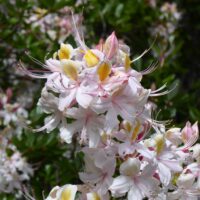
Rhododendron occidentale
A much sought after and admired native deciduous shrub found in moist places and stream banks in many plant communities throughout California. Leafs out in the spring with bright green foliage on a shrubby framework 3-6 ft. or more tall and wide. Glorious displays of fragrant azalea flowers in dense terminal clusters appear in late spring and can be pure white to pale pink often with yellow or orange markings. Needs decent light to bloom well but appreciates light shade, acid soils and regular water. Deer resistant