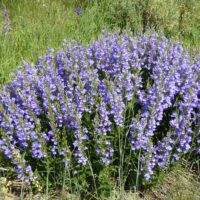
Penstemon venustus
This jewel of the mountains displays richly toned, trumpet-shaped flowers of blue to lavender held on stalks reaching 1 – 3 ft. tall. Dark green, serrated leaves form a low mound up to 2ft. wide over time. Hummingbirds love the tubular flowers as do bees. Plant in full sun with excellent drainage and water infrequently. While native to much of the West, this penstemon doesn’t quite make it into California.
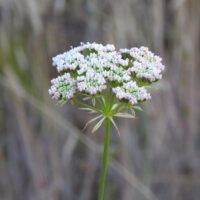
Perideridia gairdneri
An interesting and rarely cultivated native perennial that grows in grasslands and meadows in central to northern California and the Sierra Nevada foothills. Narrow leaves emerge in the spring giving way to lovely 4 ft. tall flowering stems topped with umbels of delicate white flowers in the summer. Looks particularly nice in mass and livens up a meadow or grassland planting that may be waning in summer. Entice the anise swallowtail butterfly with a NATIVE larval food source. Plant in full sun to light shade with a little water. Allow to go dry after flowering.
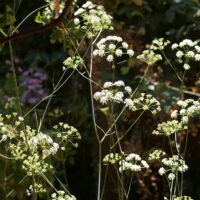
Perideridia kelloggii
An interesting and rarely cultivated native perennial that grows in grasslands and meadows in central to northern California and the Sierra Nevada foothills. Narrow leaves emerge in the spring giving way to lovely 4 ft. tall flowering stems topped with umbels of delicate white flowers in the summer. Looks particularly nice in mass and livens up a meadow or grassland planting that may be waning in summer. Entice the anise swallowtail butterfly with a NATIVE larval food source. Plant in full sun to light shade with a little water. Allow to go dry after flowering.
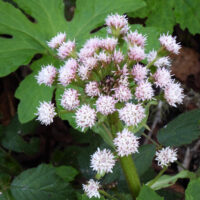
Petasites frigidus var. palmatus
A bold, beautiful and AGGRESSIVE creekside native, found in coastal and montane regions in California, north to Alaska, where it grows along shady creek banks. The large, almost tropical, palmate leaves spread from thick creeping rootstocks to form large colonies. Flowers before the foliage fully emerges in the spring with flat topped clusters of white to pink flowers on 1-2 ft. tall stems. Requires shade and plenty of water and is useful as a soil stabilizer. To control its spreading nature, use in containers or in contained areas. It won't spread into areas which are dry. Dies back to the ground in the winter. Flowers attractive to a wide range of beneficial insects.
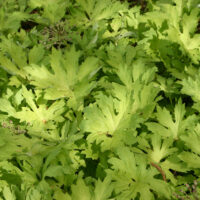
Petasites palmatus ‘Golden Palms’
Here is an exciting introduction of the western coltsfoot with wonderful golden foliage. Native to streamsides in low elevation forests, the broadly palmate leaves spread by creeping rhizomes. Careful thought should be given to its placement as it can be invasive. This bold foliage plant is great in containers or contained areas with regular water and part shade. Dies back to the ground in winter.
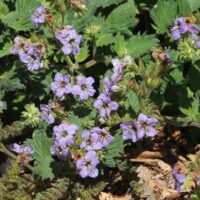
Phacelia bolanderi
Easy to grow perennial for part shade and a little summer water. Native to slopes and canyons of coastal forests in northern California. Forms low mounds of soft foliage 6 - 8 inches tall by 2 ft. or so wide. Pretty powder blue-purple one inch flowers late spring into summer offer nectar to hummingbirds, bees, and butterflies. The seeds are enjoyed by songbirds. Though somewhat short-lived, it often reseeds. Appears to be deer resistant.
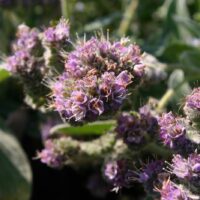
Phacelia californica
A low elevation species inhabiting bluffs, open slopes, road cuts and canyons of our inner and outer Coast Ranges down through the central coast. Forms perennial clumps of crinkled gray leaves. Stout stems rise above the rosette one foot to 18 inches tall with large coils of lavender flowers. Excellent rock garden subject. Plant in sunny areas with good drainage where it will be drought tolerant, and will do fine with a little summer water. Phacelias are great for attracting bees and butterflies.
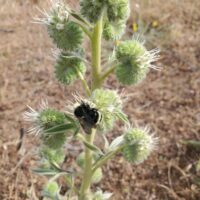
Phacelia imbricata
Native to dry slopes and open woodland throughout much of California, this rarely-offered perennial phacelia thrives in heat. Creamy-white flowers form curly clusters atop stalks ranging from 1 to 3 feet. Bees and butterflies find them irresistible. The soft, dense foliage hugs the ground in an up-to-2-ft-wide mound. Plant in full sun to light shade in areas with good drainage and minimal irrigation once established. Drought tolerant.
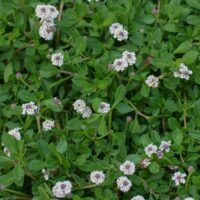
Phyla nodiflora
Vigorous, spreading ground cover native to California, North America and other parts of the world. It's a tough one, able to survive a wide range of conditions and soil types. Tolerates both drought and flooding, but best with occasional deep watering in full sun to very light shade. Flowers heavily over a long period with charming little heads of mauve-pink, lavender and white blossoms, delighting an assortment of bees and butterflies. This dense, carpeting plant makes a serviceable ground cover or lawn-like replacement, tolerating moderate foot traffic and occasional mowing. May look rough in the winter, but quickly recovers in spring. Free flowering and pollinator friendly.

Plantago maritima
From coastal bluffs up and down the California coast comes this charming little plantain. Starting in late spring and continuing through summer, small, greenish-yellow flowers flank the top of slender stems up to 6 inches tall. The dense rosettes of narrow, succulent leaves provide a striking accent in a rock garden or nestled in crevices between pavers or stones. A good container specimen. Recognized for its edible and medicinal uses. Plant in full sun to light shade. Tolerates low to regular moisture. May spread vigorously by seed.
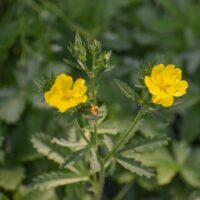
Potentilla gracilis
Prolific displays of bright yellow flowers resembling buttercups make this little cinquefoil a hit from spring through autumn. Flowers are held on two foot stems above low mats of dissected,dark green leaves. Native to mountainous areas throughout California. Provide full sun to light shade and give occasional to regular moisture. Will spread slowly by seed if exposed soil is nearby. A favorite of bees and butterflies. Deer resistant.
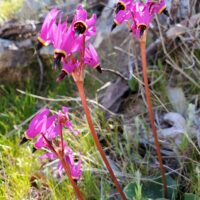
Primula (Dodecatheon) hendersonii
Description coming soon! Also known as: Primula hendersonii
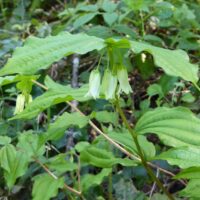
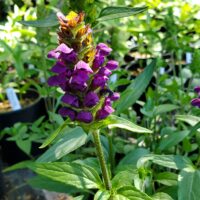
Prunella vulgaris v. lanceolata
Native to moist areas usually near coniferous forests and woodlands. Creeping perennial forms a low dense mat of foliage. Upright spikes of purple flowers over a long period summer - fall. Give some thought to placement because if happy it will reseed vigorously. Plant in full sun or light shade with regular water.
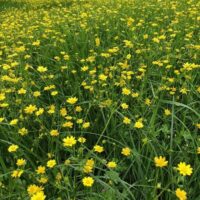
Ranunculus californicus
Cheerful harbinger of spring, this western native grows in vernally moist sites in a number of plant communities throughout California. Easy to grow perennial, sports bright green succulent foliage topped with slender stems 1 to 2 ft. tall and wide. A profusion of shiny, bright yellow blossoms bloom freely until soil dries out. Goes dormant with drought, returning in spring, often reseeding. Full sun to light shade. Excellent early pollen and nectar source, attractive to bees and other beneficials.
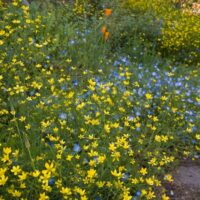
Ranunculus occidentalis
Native to open woodlands and meadows, this buttercup often occurs under deciduous oaks and buckeyes or on edges of forests. Perennial, with basal foliage, the flower stems rise 12 to 20 inches with bright yellow shiny petals. Has been surprisingly adaptable. Does fine with moderate summer irrigation, where it stays evergreen and long blooming. Once established can be allowed to go summer dry, where it will go dormant after setting seed, and returning with the winter rains.
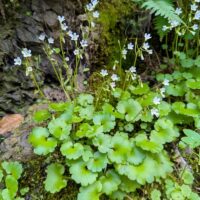
Romanzoffia californica
The California mistmaiden is diminutive, reaching a bit over a foot tall when its dainty white flowers are in bloom. The bell-shaped blossoms appear in winter, perched in clusters on tall, thin stems above lush foliage. Summer dormant until the first autumn rains, this plant is often the first garden greenery to return after a hot, dry summer. At home in the Coast Range from the Santa Cruz Mountains north to Oregon, it requires light shade and decent moisture during the growing season. Allow to go dry when the rains stop. Great for rock gardens and small nooks with excellent drainage.
Romneya coulteri
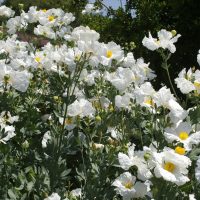
A much admired, spectacular, shrub-like perennial, with a long history in cultivation. Can be both finicky to get going and extremely vigorous once established. The large flowers are made up of crinkly, crape paper-like, white petals with a shaft of yellow stamens in the center, at the top of long, gray-foliaged stems. Plant where its size and spreading won't be a problem and prune severely in winter. Height 4 -8 feet. Full sun. Drought and deer tolerant.
Rudbeckia californica
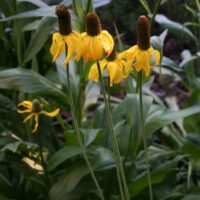
Large, bold perennial native to montane seeps and meadows where they receive regular moisture. The big leafy clumps can become very large growing 3 foot tall or more. Midsummer brings showy yellow daisies on tall stems with a distinctive long central cone and a skirt of three inch yellow petals. Plant in sun to light shade with regular water. Highly attractive to bees and other pollinators.
Rudbeckia glaucescens
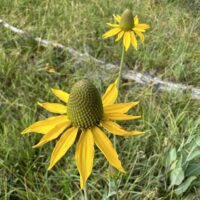
This uncommon coneflower hails from the Klamath Mountains of northern California and southern Oregon. While similar in flower to the California coneflower, featuring yellowish-brown cones encircled with a skirt of long, yellow petals, this species has waxy leaves tinted a striking blue-gray. The flowers perch atop leafless stalks reaching 3 to 4 ft tall, rising above the large, lance-shaped leaves. A favorite of bees and butterflies. Even though this species normally occurs in serpentine soils, it grows easily in almost any soil type, as long as it is kept moist. Enjoys regular to moderate irrigation and full sun to part shade.
Rudbeckia occidentalis
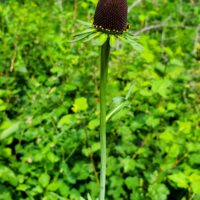
From mountains in Northern California and throughout the West comes this unusual and distinctive coneflower. Deep purple, almost black cones sit atop a star of green sepals without any petals to distract from the striking form. Large, pointed green leaves climb up the flowering stems which can reach 5 or 6 ft. high. Slowly spreads to form a small clump in moist locations with decent drainage. Will tolerate full sun near the coast, but some afternoon shade is needed in hot, inland areas. An excellent pollinator plant from the sunflower family attracting bees and butterflies. Works well in a container. Winter deciduous.
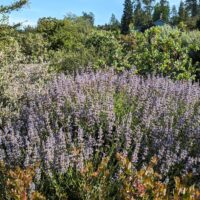
Salvia ‘Mrs. Beard’
This cultivar has been around since 1965, a chance seedling discovered in a Berkeley garden. A hybrid between Salvia sonomensis and Salvia mellifera, 'Mrs. Beard’ has proven durable and disease resistant. Forms a dense mat of gray fragrant foliage up to 2 ft. tall and 4-6 ft. wide. Spring brings an abundance of tiny pale lavender-blue flowers in ball-like clusters that are highly attractive to bees and hummingbirds. Plant in full sun along coast and light shade in hot inland sites, where it will be quite drought tolerant once established. Deer resistant.

Salvia clevelandii x ‘Allen Chickering’
Delightfully fragrant hybrid sage between S. clevelandii and S. leucophylla. Blue lavender flowers in whorls during summer. Grows 3 - 5 ft. tall and wide. Good for dry sunny areas. Attractive to hummingbirds, bees and butterflies. Deer resistant.
Salvia greggii ‘Furman’s Red’
Selected in the 1970’s and a Plant Select winner in 2005, this dependable selection persists in the trade for its profuse displays of dark-red flowers and cold tolerance. Growing 3 to 4 feet tall and 2 to 3 ft. wide with light-green, aromatic foliage. The magenta blossoms can bloom spring through fall and attract hummingbirds, butterflies and other pollinators. Prefers full sun with decent drainage and is drought tolerant once established. Deer resistant.
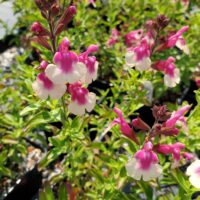
Salvia greggii ‘Mirage Rose Bicolor’
Top winner at the Welby Flower Trials in Colorado, this hybrid sage was bred for long blooming and heat tolerance. Compact and tidy, growing 12 -14 inches tall and a bit wider. The fragrant foliage is topped with a profusion of nectar-rich, two toned flowers of deep rose-pink and creamy-white, summer into fall. The appealing, bold display attracts hummingbirds, butterflies and bees. Plant in full sun to light shade with moderate to occasional water. Makes a good container subject. Deer resistant.
Salvia greggii ‘Radio Red’
This new cultivar of autumn sage offers larger, vivid red flowers and a more compact habit. Despite it's common name, autumn sage blooms over a long period, beginning in late spring, into summer and through autumn. Well branched shrubby habit with neat, fragrant foliage growing 2 - 3 foot tall and wide. Can be grown as a single specimen, lightly clipped as a low, informal hedge or in a container. Plant in full sun with moderate to occasional summer watering. The true, bright red flowers are highly attractive to hummingbirds as well as bees and butterflies. Deer resistant.
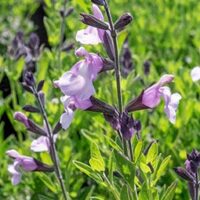
Salvia greggii ‘Smokin’ Lavender’
Yet another cultivar of autumn sage, a sturdy and floriferous perennial, native to the southwest U.S. and Northern Mexico. A great addition to the pollinator garden where it provides copious nectar to bees, butterflies and hummingbirds throughout the summer and fall. A compact evergreen with aromatic foliage, growing about 2 ft tall and wide. Soft, lavender blossoms emerge from dark purple calyces and bloom freely over a long period. Plant in full sun to very light shade with moderate to occasional watering once established. Good container plant. Deer resistant.
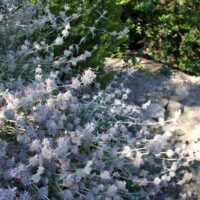
Salvia leucophylla ‘Figueroa’
A beautiful selection of the native gray sage. Forms a compact shrub 3 - 4 ft. tall and more than 6 ft. wide. The gorgeous whitish-gray foliage is topped with long stems of lavender-pink flowers in whorls. Good choice for a dry sunny bank where it is heat, drought and deer tolerant. This species attracts bees and hummingbirds.
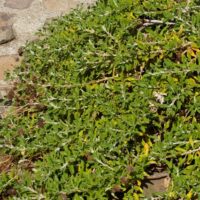
Salvia mellifera ‘Terra Seca’
Here is an interesting form of the normally upright, native black sage. 'Terra Seca' grows to about 2 1/2 ft. tall and 5 ft. wide. Perfect for a dry sunny bank where it will cover the ground densely and thickly. It will spill over a wall beautifully. The flowers are pale lavender. Deer and drought resistant. This species attracts bees and hummingbirds.
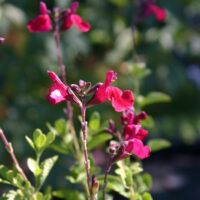
Salvia microphylla ‘Heatwave Blaze’
The Salvia ‘Heatwave Series’ are selections from Salvia greggii / microphylla crosses. ‘Heatwave Blaze’ offers displays of dark crimson flowers over a long period from summer into fall. Compact, rounded habit, growing up to 3 feet tall and wide. Plant in full sun to light shade. Drought tolerant but best with an occasional deep watering during the growing season. Attractive to bees, butterflies and hummingbirds. Deer resistant.