
Achillea millefolium – Bodega Bay form
Larger leaves up to 10 inches long distinguish this form from most other local yarrow selections. While most yarrow from our coastline have very green leaves, this strain is on the grey side. From spring through autumn, large white flower clusters sit upon stalks about to at least 2 feet in height. Water occasionally in areas away from the coast and provide full sun. The foliage is deer resistant.

Achillea millefolium – inland form – Lake County seed source
A vigorous and easy to grow perennial, yarrow grows native throughout California in many plant communities. This crop is grown from seed collected from a hot inland site in Lake County. In this form, flower stems rise 18 inches above the gray ferny foliage bearing white flowers in flat topped clusters. Plant in a sunny location with moderate to a little water. Spreads by rhizomes and can form sizable clumps if happy. A good addition to the habitat garden where the flowers provide nectar for bees and butterflies and the foliage provides winter forage for birds. The foliage is deer resistant.

Achillea millefolium – inland form – Napa County seed source
A vigorous and easy to grow perennial, yarrow grows native throughout California in many plant communities. This crop is grown from seed collected from a hot inland site in Napa County. In this form, flower stems rise 18 inches above the gray ferny foliage bearing white flowers in flat topped clusters. Plant in a sunny location with moderate to a little water. Spreads by rhizomes and can form sizable clumps if happy. A good addition to the habitat garden where the flowers provide nectar for bees and butterflies and the foliage provides winter forage for birds. The foliage is deer resistant.

Achillea millefolium – inland form – Sonoma County seed source
A vigorous and easy to grow perennial, yarrow grows native throughout California in many plant communities. This crop is grown from seed collected from a hot inland site in Sonoma County. In this form, flower stems rise 18 inches above the gray ferny foliage bearing white flowers in flat topped clusters. Plant in a sunny location with moderate to a little water. Spreads by rhizomes and can form sizable clumps if happy. A good addition to the habitat garden where the flowers provide nectar for bees and butterflies and the foliage provides winter forage for birds. The foliage is deer resistant.
Achillea millefolium – Montara Mountain form
We discovered the parent of this giant seed strain on the lower slopes of Montara Mountain in San Mateo Co.. With broad, white flower clusters reaching up to 4 ft. high, this is the largest yarrow we've encountered. While seedlings can vary, we have high hopes for this new introduction. Give full sun and moderate to infrequent irrigation. Potentially an excellent spreading perennial for a tall meadow. Attracts all sorts of pollinators. The green, fuzzy leaves are usually considered to be deer resistant.

Achillea millefolium ‘Island Pink’
A color variant of the normally white California native yarrow from Santa Cruz Island. Dark green ferny foliage topped with clusters of bright pink flowers on 18 inch stems over a long period. Sun to partial shade, occasional to moderate water. Good habitat value, providing nectar for bees and butterflies. The foliage is deer resistant.

Achillea millefolium ‘Red Velvet’
This yarrow is getting rave reviews for its deep-red flowers produced atop grey-green ferny foliage. Spreading 2 foot or so wide with flowers rising 2 – 2 ½ feet tall. Best in full sun with moderate to occasional watering. Popular with bees and butterflies. Often deer resistant.

Achillea millefolium ‘Sonoma Coast’
This is a local selection from the Sonoma County coast near Salmon Creek. Bright green foliage is topped with white flowers in dense heads on compact stems to around 1 ft. tall. Can bloom over a long period, spring through fall, depending on conditions. Best in sunny areas with some summer water, though it is drought tolerant. Flowers attract butterflies and other insects. The foliage is deer resistant.

Achillea millefolium ‘Terracotta’
This hybrid yarrow forms a mat of grey-green ferny foliage 2 - 3 ft. wide with interesting earth-tone colored flowers. The long-lasting flower clusters simultaneously sport peachy-yellow tones through burnt orange, on sturdy non-floppy stems to around 2 ft. tall. Plant in full sun with moderate to occasional summer water once established. Bees and butterflies love yarrows, but they are not deer favorites. Excellent cut flowers too.

Agastache ‘Coronado Red’
Agastaches are rewarding perennials with fragrant foliage and abundant flowers, which are highly attractive to hummingbirds and butterflies. ‘Coronado Red’ has a vertical growth habit with silvery foliage to 2.5 ft. tall and 2 ft. wide. Spikes of orangy-red flowers bloom over a long period in the summer delighting the hummingbirds. Requires good drainage and full sun with moderate to occasional summer water. Deer resistant.
Agastache ‘Morello’
Calling all pollinators! Hummingbirds, bees and butterflies will delight in the large, dense flower spikes of deep, burgundy-rose on this fragrant perennial. This summer bloomer has minty scented foliage which has a purple blush early in the season, growing 2 -3 ft. tall and 2 ft. wide. Plant in full sun with good drainage and moderate to occasional watering. Good in container plantings, too. Deer resistant.


Agoseris grandiflora
With a wide distribution throughout the state, the California dandelion is much more refined and well-behaved than its European, weedy look-alike. Found in oak woodland, chaparral, and many other plant communities in part-shade or bright dappled light. Slender, dissected, low, fuzzy gray-green leaves give rise to stem-like peduncles up to 2+ feet tall that are topped with rounded, flat, gold-yellow flower clusters from March-May, followed by large, perfectly rounded white globes of seeds that are wind-dispersed. Plant in part-sun or in areas with bright dappled light that drain well and are summer dry. Does not reseed aggressively like the European dandelion. Drought-tolerant.

Agrostis pallens
A fine textured, drought tolerant, spreading, perennial grass that forms an undulating, naturalistic, meadow look, or can be mowed and used as a lawn substitute. Native to meadows, open woodlands and forests in many plant communities in California north to British Columbia. Grows 1 -2 ft. tall with airy flower stems in late spring to early summer. May be shy to flower in shady areas. Plant in sun to light shade, with decent drainage, where it will accept both water and drought. Will go dormant in summer without irrigation. If using as a lawn substitute, it will need summer irrigation, though requiring far less than a traditional lawn. Excellent understory among trees or shrubs, for rain gardens, bio-swales, meadows or mowed as a lawn substitute. Host plant for a number of butterflies. Deer resistant.
Agrostis scabra
Native to middle and high elevation forests and meadows throughout California, this small bunchgrass forms dense tufts of blue-green foliage about six inches high with airy inflorescences rising another eighteen inches. Works well in a meadow planting or in a container. Combine with other small perennials such as Grindelia and yarrow or plant in large masses to show off the delicate grass flowers. Needs regular moisture and full sun to light shade. Deer resistant.

Allium amplectens ‘Graceful Beauty’
This western native onion grows in sunny openings in forests and woodlands, often on serpentine. Narrow, fragrant leaves make way for globe shaped flower heads on sturdy stems 12 - 16 inches tall. The flower heads which emerge in late spring and early summer are made up of many starry, white florets with elegant lavender anthers and pale pink veins. Papery bracts persist after blossoms fade, adding interest. If happy can reseed readily. Attractive to bees and butterflies. Very drought tolerant. Reported to be gopher resistant, but may need further analysis. Deer resistant.

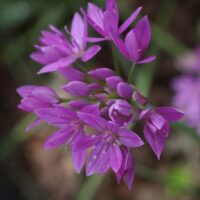
Allium unifolium
An adaptable and easy to grow native onion with handsome blue-green foliage. Late spring brings beautiful lavender-pink flowers on short stems 6 - 8 inches tall. Native in the Coast Range from the Central Coast, northwards. The flowers on this form have a particularly appealing saturated color. The original plants were given to us by the internationally known bulb expert and native plant horticulturist, Wayne Roderick. Fairly water tolerant, often found on seasonally moist and heavy soils. Spreads vigorously by seeds or bulb offsets. Goes dormant after bloom and will tolerate dry conditions at that time. Attractive to bees and butterflies. Reported to be gopher resistant. Deer resistant.
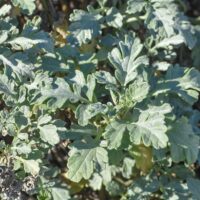
Ambrosia chamissonis
The silvery mats of this sand-dwelling species are important for soil stabilization along our coastline, but can also be used as an attractive, evergreen groundcover in the garden setting. Dissected leaves line crawling branches, forming a dense carpet up to about 10” high and spreading wherever they have room to grow. While vigorous, it can be pruned back easily. In summer, short stalks of inconspicuous, cream colored flowers raise, followed by bur-like seed capsules. Plant in sunny locations with moderate to occasional irrigation. Tolerant of different soil types.
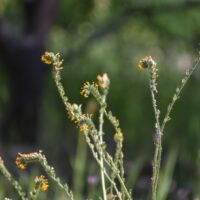
Amsinckia menziesii
A bright, yellow-orange ANNUAL with curled clusters of little trumpet-shaped flowers resembling the scrolled head of a violin. Flower stalks of one-to-three feet tall gradually unfurl with new blooms from mid-spring to early summer. The warmly-colored blossoms are a great nectar source for butterflies and develop into seeds adored by goldfinches and other songbirds. This grassland native adapts to the garden setting, where it prefers full sun and occasional irrigation. Will self-sow.
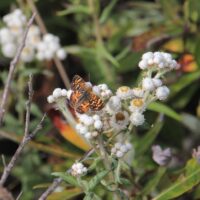
Anaphalis margaritacea
An adaptable plant with silver-green leaves that are densely white and woolly beneath. The flowers appear in summer and are made up of pearly white papery bracts surrounding yellow centers. The “straw flowers” retain their shape and color and are often used in dried arrangements. Tolerant of almost any soil type, it prefers full sun where it will grow in moist to somewhat dry conditions. Can spread vigorously, perhaps best used in meadow plantings or other naturalistic settings. Grows 1 - 3 ft. tall and spreading. Dies back to the ground in the winter. Larval food source for the painted lady and American lady butterflies. Deer resistant.
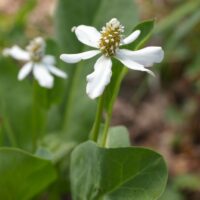
Anemopsis californica
An unusual plant - native to wet areas, but adaptable to regular or moderate garden water. The low rosettes of leaves spread into attractive colonies. The white flowers, or actually, flower bracts, are very showy in late spring. Sun to light shade with moisture. Herbalists use roots and leaves for a topical antibiotic and other uses.
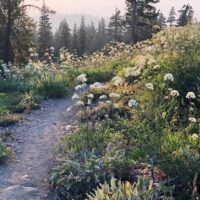
Angelica breweri
From the Sierras and the Klamath mountains comes this elegant member of the carrot family. Clear white flowers perch like little stars in flat-topped clusters up to 10 inches wide. Flower stalks can reach 6 feet in height with green serrated leaves forming 2 foot tall mounds at the base. Enjoys dappled shade away from the coast and moderate water. Great for native bees and butterflies. A larval food source for the anise swallowtail butterfly.
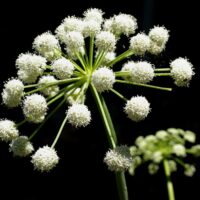
Angelica tomentosa
This species offers striking, flat-topped clusters of white flowers held up dramatically on stalks reaching up to around 5 ft. tall. Handsome, pinnately compound, gray-green leaves mass at their base. A generally inland angelica found in more or less moist, lightly shaded places, usually on serpentine. It can grow in full sun as long as it has plenty of moisture during the growing season. An important plant for the Pomo for its many medicinal and shamanistic uses. Diverse pollinators utilize the flowers, while the anise swallowtail butterfly uses the stems and leaves as a host plant for the catterpillars. Enjoys moderate water in the garden with a late summer rest (low water).
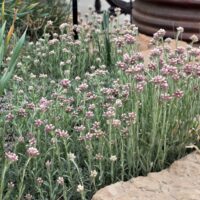
Antennaria rosea
A charming, native, mountain dweller which grows among rocks and onto boulders at meadow edges. Forms low mats only a couple of inches high of woolly, gray leaves that creep and cascade. Short flower stems with small, creamy-white and rosy-pink papery bracts, bloom summer into fall. Plant in full sun to very light shade with good drainage and a little summer water. Good addition for the pollinator garden and is the larval food source for a number of butterflies including the American lady. This is one of the few natives which is so low growing you can plant it between stepping stones.
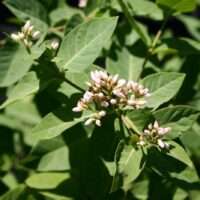
Apocynum cannabinum
Native throughout much of North America, California and our own Santa Rosa Valley. Grows 3 ft. tall and spreads vigorously by roots to form large patches. Small white flowers in summer. Turns beautiful shades of yellow in the autumn then dies back to the ground in the winter. Good for wild meadow or ethnobotanical garden. Important to Native Americans who used the stems for cordage, rope, twine nets etc. Sun to light shade with some moisture. Will tolerate dry conditions after blooming. Very attractive to butterflies. BEWARE! SPREADS VIGOROUSLY!
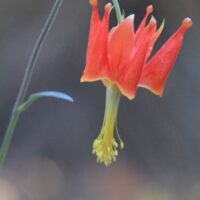
Aquilegia eximia
Large, orangey-red flowers with yellow stamens adorn this beautiful and uncommon native columbine. The pendant, brightly colored blossoms are larger than those of the western columbine but just as attractive to hummingbirds. Forms a 1 ft. high mound of foliage with flowering stalks reaching up to 5 ft. tall. Native to the Coast Ranges from Mendocino to Ventura Counties often on serpentine soils. Provide full sun to part shade and only water enough to prevent the soil from drying out completely. In areas far away from the coast provide a little shade from the hot afternoon sun. This species is a little more drought tolerant than the more common Western columbine.
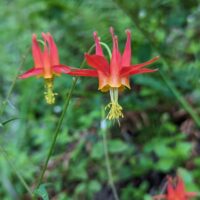
Aquilegia formosa
A popular native perennial with fern-like foliage and wonderful, nodding, spurred blossoms of red and yellow. Best with a little shade and moderate to regular moisture, but will tolerate full sun in somewhat cooler climates. The flower stalks reach 1 1/2’ to 3’ tall, with the grey-green foliage forming a mound of about 1 ft tall and wide. Flowers attract hummingbirds, while the seeds are relished by small birds such as sparrows and Juncos. If seed pods are left on the plants, you may get volunteer seedlings in the fall.
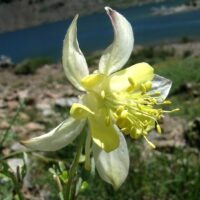
Aquilegia pubescens
Found on open, rocky slopes in the southern Sierra Nevadas in sub-alpine and alpine plant communities. Low rosettes of divided, blue-green foliage, sprout from a taproot. Flower stems rise 10 - 20 inches above the fragrant foliage and carry upward facing, nectar rich, long spurred flowers, perfectly positioned for pollinating hawk moths, hummingbirds and butterflies. The flower color is variable and runs the gamut from cream to yellow to pink, often in delicate hues rather than solid colors, except for an occasional pure white. Hybridizes freely with the native red columbine, which invites various shades of red to the flower color possibilities. Grows well in low elevation gardens, given light shade and summer water.
Arnica chamissonis
Native to moist meadows in mountainous regions of California and western North America. This delighful perennial grows 1 - 2 feet tall and wide with cheerful, bright golden-yellow daisies in early summer. The bright green, lance-shaped leaves sit in opposite pairs along them stems. Grow in full sun to light shade with decent draining soils and regular moisture. Said to have the same medicinal properties of its European cousin, but easier to grow. Flowers support bees, bumblebees and butterflies. Winter deciduous. Deer resistant.