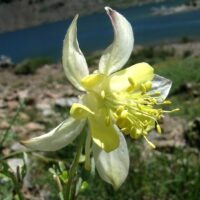
Aquilegia pubescens
Found on open, rocky slopes in the southern Sierra Nevadas in sub-alpine and alpine plant communities. Low rosettes of divided, blue-green foliage, sprout from a taproot. Flower stems rise 10 - 20 inches above the fragrant foliage and carry upward facing, nectar rich, long spurred flowers, perfectly positioned for pollinating hawk moths, hummingbirds and butterflies. The flower color is variable and runs the gamut from cream to yellow to pink, often in delicate hues rather than solid colors, except for an occasional pure white. Hybridizes freely with the native red columbine, which invites various shades of red to the flower color possibilities. Grows well in low elevation gardens, given light shade and summer water.
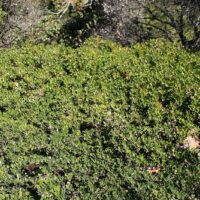
Arctostaphylos uva-ursi ‘Green Supreme’
A superior garden hybrid of the trailing bearberry. A volunteer seedling discovered by staff at Tilden Regional Parks Botanic Garden. Ultimately spreads 6 - 12 ft. across and less than a foot tall. Enjoys moderate to occasional irrigation. The glossy bright green leaves create a beautiful groundcover. Tolerates a wide range of soil types with reasonable drainage. Very disease resistant and fast growing. Shy to bloom or set berries. Sun to part-shade.
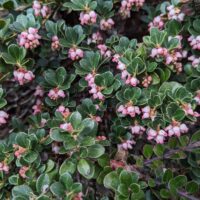
Arctostaphylos uva-ursi ‘Point Reyes’
An unusual selection of our native bearberry discovered near the Point Reyes lighthouse in Marin County. Dark green, leathery leaves form distinctive whorls along the stems with pale pink, urn-shaped flowers emerging in early winter. The showy red berries contrast nicely with the dark green leaves. Reaching a height of about 18” and a width of at least 6 ft., this groundcover works well in a rock garden or mixed with other low shrubs and grasses from our coastal areas. Give moderate water in interior locations and protect from the hot afternoon sun.
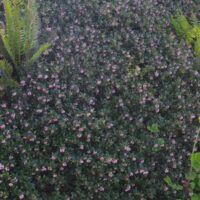
Arctostaphylos uva-ursi ‘Radiant’
A very low mat of glossy, dark green foliage 6 - 8 inches high and creeping at least 6 ft. across. Light pink flowers in early winter are followed by showy red berries. In hot inland areas give moderate water and light afternoon shade. A sturdy evergreen groundcover.

Arctostaphylos uva-ursi ‘Samoa Dunes’
This Humboldt County selection of the ubiquitous bearberry distinguishes itself with large, rounded, glossy leaves of deep green. Reaching a height of about 6 inches and a width of at least 6 feet, this durable groundcover spreads quickly to form a weed-smothering carpet. Little urn-shaped flowers colored soft pink appear in spring and are followed by shiny red berries. Provide full sun to part shade and moderate to occasional irrigation once established. Protect from the hot afternoon sun in warmer areas. The shiny, dark green foliage combines well with grey-leaved plants such as Artemisia ‘David’s Choice’ and the fescue ‘Patrick’s Point’.
Arctostaphylos uva-ursi ‘San Bruno Mountain’
A beautiful selection of bearberry from San Bruno Mountain south of San Francisco. This groundcover manzanita forms a luxuriant mat of large, glossy, spatulate leaves spreading to around 6 feet wide. The soft pink urn-shaped flowers lead to big red showy berries. A natural for coastal plantings where it can grow in full sun with little to no summer water needed. Inland, bearberry does best with shade from the hot afternoon sun and moderate summer watering.
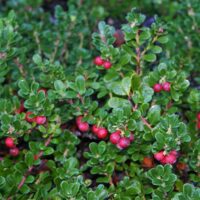
Arctostaphylos uva-ursi ‘Wood’s Compact’
A low growing, spreading manzanita with lustrous green, rounded foliage, little pink urn-shaped flowers and pretty red berries, quite large for the species. This selection from coastal Oregon spreads at a moderate pace to 6-8 feet wide and only getting 6-8 inches tall. Full sun to light shade in hot areas with moderate summer water.

Aristolochia californica
Dutchman’s pipe vine is an interesting vine native to river, stream side and woodland habitats. Soft heart-shaped leaves and unusual purplish pipe-shaped flowers bloom in early spring. This deciduous twining plant will need some support if you wish it to grow upwards. Adaptable, but best with a little shade and moderate water. Slow to establish, we offer this adage to encourage patience: “The first year it sleeps, the second year it creeps and the third year it leaps”. Once established it will put on ample growth, easily covering a trellis or chain link fence. THE larval food source for the pipevine swallowtail butterfly. Deer resistant.
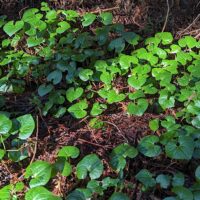
Asarum caudatum
Native to the deep shade of forest floors, this evergreen perennial forms a handsome low groundcover. The large, deep green, heart-shaped leaves appear to hover over the ground, creating a lush, almost tropical effect. The unusual flowers which nestle under the leaves are normally maroon, but occasionally white, with long spidery tails. Thrives in the deep shade under redwoods, competing well with the aggressive roots and dense duff. The ginger scented leaves are deer resistant.

Asarum caudatum ‘Alba’
An interesting form of the native, shade loving wild ginger. Calling the flowers white is a stretch, they are more of a wasabi-green rather than the usual maroon color of the species. The intriguing long tailed flowers are hidden beneath the glossy heart shaped leaves and would need to be planted on a wall, slope or container to make them easier to view. Wild ginger prefers shade and moisture where it will form a low spreading groundcover.
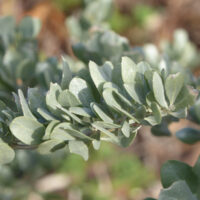
Atriplex lentiformis
This native bird favorite is a tough and useful shrub with beautiful silvery gray foliage. Growing 5 ft. or more tall and spreading widely, quail bush is valued for its ability to deal with difficult sites where it tolerates wind, salt spray, saline and alkaline soils. A terrific habitat plant, providing food and cover for a wide array of birds and mammals. Native from the coast to the desert. Excellent for erosion control and is fire resistant. Benefits from annual shearing and occasional aggressive pruning to rejuvenate. Plant in full sun with occasional to little summer water.
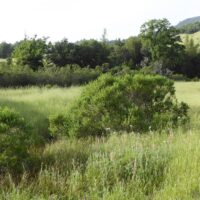
Baccharis pilularis
This is the upright form of coyote bush, growing 4 - 8 ft. tall and wide. Valued for its ability to flourish in a wide range of conditions. Also valued as an excellent habitat plant offering food and cover to a wide variety of wildlife. Flowers are not showy and the male and female flowers are borne on separate shrubs. This crop of plants are a mix of males and females and one can’t tell until they bloom. Plant in sunn or light shade. Not fussy about soils. Quite drought tolerant once established. Responds well to pruning or shearing, working well as a screen. Deer resistant.
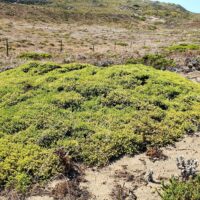
Baccharis pilularis – Bodega Dunes form
Coyote bush is a tough, native, evergreen shrub, forming mounds of dense foliage that hold soil and provide food and cover for birds and mammals. Flowers are small and cream-colored and appear in the autumn. This crop is grown from seed collected in the Bodega Bay Dunes from parents that were under two feet tall and around 6 ft or so wide. Time will reveal the exact form and sex of each plant in this crop. Both male and female plants have significant habitat value, with their combined contributions of abundant pollen, nectar and copious seed late in the season. It will be a surprise as well as a useful addition to the habitat garden. Plant in full sun, though a little shade is helpful in hotter sites. Shear occasionally to renovate and keep dense. Drought tolerant on the coast, but best with occasional water inland. Deer resistant.
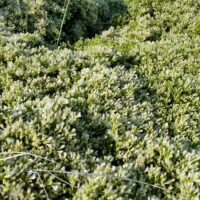
Baccharis pilularis – female
Upright form of coyote brush, growing 4 - 8 ft. tall and wide. Valued for its ability to flourish in a wide range of conditions. Also valued as an excellent habitat plant offering food and cover to a wide variety of wildlife. Flowers are not showy and the male and female flowers are borne on separate shrubs. Theses plants are FEMALE and will produce seed (when male plants are present). An abundance of pollinators and beneficial insects use Baccharis flowers and birds love their seeds. Plant in sun to light shade. Not fussy about soils. Quite drought tolerant once established. Responds well to pruning or shearing and is useful as a screen. Deer resistant.
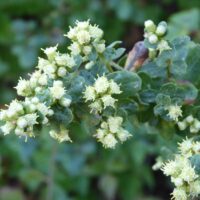
Baccharis pilularis – male
Upright form of coyote brush, growing 4 - 8 ft. tall and wide. Valued for its ability to flourish in a wide range of conditions. Also valued as an excellent habitat plant offering food and cover to a wide variety of wildlife. Flowers are not showy and the male and female flowers are borne on separate shrubs. These plants are MALE and produce ivory colored flowers with pollen and nectar. An abundance of pollinators and beneficial insects use Baccharis flowers. Plant in sun to light shade. Not fussy about soils. Quite drought tolerant once established. Responds well to pruning or shearing and is useful as a screen. Deer resistant.
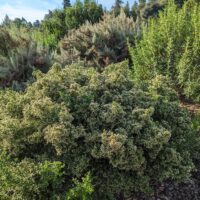
Baccharis pilularis ‘Mayacama Mound’
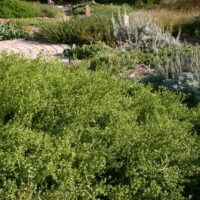
This dense, bright green, gumdrop-shaped coyote bush only reaches about 3 ft tall and spreads a wider. We discovered this heat and drought tolerant selection in a batch of seedlings from inland Sonoma Co.. A great alternative for the ubiquitous ‘Twin Peaks’, which is a coastal selection and less suitable for hot, dry sites. Plant in full sun to light shade where mature plants won’t need supplemental water, but an infrequent deep soak will keep them looking fresh. The small, whitish flowers are relished by pollinators in the early autumn. This selection is female, so the late autumn seeds provide an important food source for birds. A sturdy, low, evergreen shrub for tough situations.
Baccharis pilularis ‘Pigeon Point’
Adaptable and dependable low growing form of the native coyote bush. Forms a mound of bright green leaves with an undulating habit 2 - 3 ft. tall and 6-8 ft. wide. Able to tolerate many soil types and watering regimes this shrub is best in full sun to light shade. Extremely drought tolerant along the coast but best with moderate to occasional summer water inland. When watered and annually trimmed to keep low and free of debris it is recommended for fire resistance landscapes. A good addition to the habitat garden, coyote bush offers excellent cover to a wide variety of wildlife. ‘Pigeon Point’ is a male selection and does not make seed. Deer resistant.
Baccharis pilularis ‘Twin Peaks’
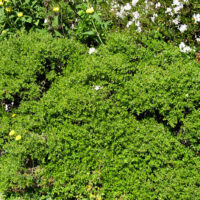
One of the fastest, toughest, densest evergreen native large scale groundcovers. Discovered on Twin Peaks in San Francisco. Grows at least to 6 ft. wide and 2 - 3 ft. tall. Extremely drought tolerant along the coast but best with moderate to occasional summer water inland. Shear hard annually in spring to keep rejuvenated. Sun on coast, afternoon shade inland. This is a male selection so it won't produce seeds. Deer don’t seem to eat it.
Berberis (Mahonia) aquifolium
This attractive, western native evergreen has a long history in cultivation for good reason. Erect stems rise 4 to 7 feet or more tall and wide, spreading slowly by underground rhizomes to form dense clumps. Bronzy-red new growth gives way to dark-green, glossy leaves with spiny margins that are prickly to the touch. Cold winters can darken the foliage with purple-red tones. Late spring brings clusters of bright yellow, sweetly scented flowers. Edible blue-black fruits follow and are pretty and tasty. A useful and adaptable shrub in a hedge or a shrubby border. Takes full sun to part shade. Performs best with some afternoon shade in hot areas and moderate to infrequent water. A great habitat plant which provides cover, nectar rich flowers and fruits relished by all. Deer resistant.
Berberis (Mahonia) aquifolium var. repens
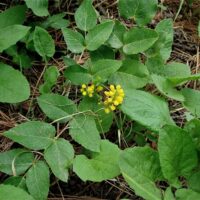
This little cousin of the much larger Oregon grape only gets 1 - 3 ft. tall and spreads underground to create dense, evergreen drifts. The divided leaves have a matte finish with a grey-green color which turns purple-red with frost. Clusters of bright yellow flowers open in spring and are followed by deep blue "grapes" much loved by birds. The sweet-scented flowers are enjoyed by bees and butterflies. Provide full sun to shade and moderate to infrequent irrigation. Deer resistant.
Berberis (Mahonia) nevinii
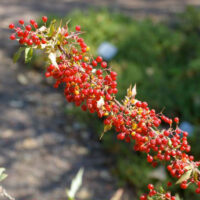
Nevin's barberry is a very rare southern California shrub with rigidly arching stems densely clothed in pointy silver gray leaflets. Heavy blooming with clear yellow flowers followed by heavy fruiting with bright red translucent fruit. 8 ft. by 8 ft. Does well in sunny well drained locations in the Bay Area. Great companion to matilija poppy and Salvia clevelandii. Very drought tolerant but best with occasional water. Deer resistant.
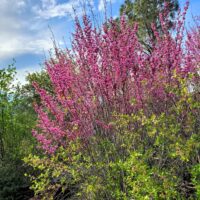
Cercis occidentalis
Beautiful in all its seasons, the native redbud is well worth growing. Highly ornamental multi-trunked shrub or small tree 6 - 20 ft. tall and wide. Masses of brilliant rose-purple blossoms in early spring followed by conspicuous long seed pods that start out lime green and age to purple-brown. The rounded heart-shaped leaves emerge apple green and develop to bluish-green. In colder areas, the leaves take a nice fall color of yellow or red. The smooth silvery-gray branches are picturesque in the winter landscape. Plant in full sun to light shade with good drainage. Drought tolerant. Important nectar and pollen source for bees. Attracts hummingbirds too.
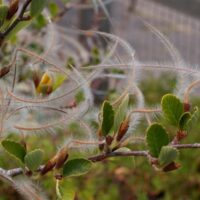
Cercocarpus betuloides
Mountain mahogany is an adaptable, semi-evergreen native shrub (8 to 12 ft. high and wide) or small tree with charming birch-like leaves set against silver-grey bark. Small, honey-scented flowers appear in spring followed by seeds with intriguing silky, curled, feather-like tails. The open habit contrasts nicely with evergreen shrubs or rock walls where its pleasing silhouette can be seen. Flowers are attractive to bees. Mountain mahogany is one of those rare native shrubs which can easily be pruned for narrow garden beds. Grows on dry slopes in chaparral or at the edges of woodlands. Provide full sun to light shade. It is surprisingly adaptable to diferent water regimes, from moderate irrigation to no water once established. Somewhat deer resistant.
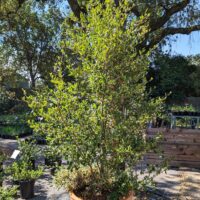
Cercocarpus betuloides var. blancheae
This rare and beautiful variety of our native mountain mahogany offers larger, birch-like leaves with fuzzy and whitish undersides. The highly useful from generally reaches 8 – 15 ft. tall, but only spreads to about 6 ft. wide, making it ideal for narrow locations where a screening, evergreen, fast-growing bush is needed. Small, disk-like, creamy flowers appear in the spring, followed in summer by seed pods with hairy, grey tails which curl upwards, giving the plant a silver halo. Over time, the trunks are covered in a smooth, grey bark. The Island mountain mahogany typically grows much more rapidly than our local variety and is tolerant of moist or dry soils once established and part shade to full sun. Heat isn’t an issue. A great candidate for a container, where it is very amenable to pruning.
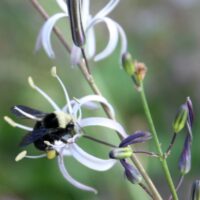
Chlorogalum pomeridianum v. pomeridianum
Known for their large, fibrous bulbs historically used by indigenous peoples and early settlers for soap, food and to stupefy fish. Long, wavy-margined leaves form a rosette in winter followed in late spring by tall, airy flower stems bearing small white flowers that open in the late afternoon and evening. Great in naturalistic settings in full sun to light shade. Needs to go summer dry once established. Larval food source for the Western Brown Elfin butterfly.
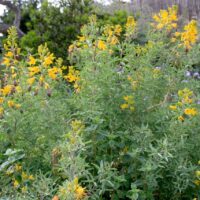
Cleomella (Isomeris) arborea
This distinctive small shrub from Southern California features clusters of golden-yellow flowers with long stamens, giving them a delicate, airy quality. The flowers are followed by papery, lantern-like seed pods which can become almost translucent with age. While this species blooms strongest in the spring, flowers can be seen year-round. Bladderpod has a loose, rounded habit, reaching 4 to 6 ft. tall and wide. If your plant becomes too lanky, simply cut it to the ground to rejuvenate it. Plant in full sun with good drainage and provide infrequent to zero irrigation once established. A great nectar source for hummingbirds, bees and butterflies. Deer resistant.
Previously known as: Peritoma arborea
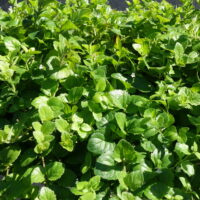
Clinopodium (Satureja) douglasii
Wonderfully fragrant native perennial with trailing stems about 6 inches tall and spreading. Roundish, scallop-edged, deliciously minty leaves have a long history of herbal uses. Tiny white flowers are borne in axils of leaves in the spring. A sweet small scale groundcover for the woodland garden with light shade and moderate to a little summer water.
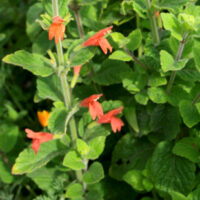
Clinopodium (Satureja) mimuloides
Native to creeksides in the mountains of southern California, this clump forming perennial is rarely seen in cultivation. Growing 2 - 3 ft. tall and wide with soft, fragrant foliage. Orangy-red tubular flowers bloom late spring to early summer and are hummingbird favorites. Plant in sun to light shade with regular moisture.
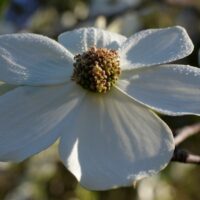
Cornus nuttallii
Spectacular native tree with pleasing horizontal branching, gorgeous white flowers, handsome fruits and good fall color. An elegant specimen tree though notoriously challenging in cultivation. Easiest to grow within its native range. Dislikes poor drainage, fertilizing, pruning, and injury to the tender bark. Drought tolerant in shady, cool situations but enjoys occasional to moderate water in fast draining soils. Once established it can become a show stopping specimen in a wooded garden, under high branching trees, along stream courses and slopes with eastern or northern exposure. Birds relish the red fruits.
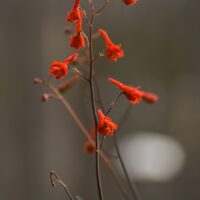
Delphinium nudicaule
In late winter and spring, scarlet flowers with elongated tails perch on upright stalks, usually not more than 3 ft tall. The green, lobed leaves which form a low mound above the ground have a distinctive pale patch in their centers. This native makes its home on summer-dry slopes throughout much of Northern California and parts of Central Ca., inhabiting bright, open woodlands and rocky road cuts. Needs good drainage and little to no irrigation in the summer. While it can grow in a fair amount of shade, it blooms best under a bright, dappled canopy. A favorite of hummingbirds and butterflies. All parts are poisonous if ingested.