
Cornus sessilis
Native to moist ravines and stream banks of the coast ranges and the Sierra Nevada Mts, this deciduous shrub or small tree grows 5-10 ft. or more tall and wide. Beautiful shiny, jade green leaves with prominent lateral veining decorate the graceful green barked stems. Small, yellow flowers appear early as it leafs out in the spring and are followed by oval fruits. Fruit color changes as it matures from greenish-white to yellow, red and finally shiny black which attract a wide range of fruit eating birds. Foliage can take on pretty tones of yellow and red in the autumn. Thrives in moist shady locations, but will grow well with just part shade and moderate to occasional summer water once established.
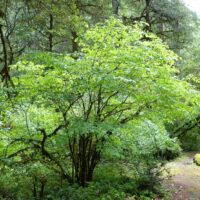
Corylus cornuta ssp. californica
Western hazelnut is a handsome, open, multi-stemmed shrub native to forests from Santa Cruz northwards in the Coast Range, and from Sequoia northwards in the Sierra foothills. Winter deciduous with decorative dangling catkins in winter. The soft, somewhat hairy leaves turn yellow in the fall. Small amounts of tasty nuts are produced in late summer and are relished by wildlife and people. Part shade with some moisture, but will tolerate fairly dry conditions once established. Usually grows 6 - 10 ft. tall. Somewhat deer resistant.
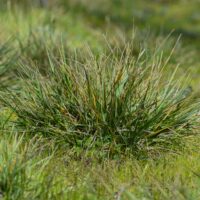
Danthonia californica
California oatgrass is a native bunchgrass found throughout mountains and coast ranges in both open and partly shaded areas. Forms dense leafy tufts with flower stalks of nodding spikelets to 1 1/2 ft. tall. Not to be confused with the invasive alien wild oats, this native makes a good basic grass for a meadow planting. Withstands trampling and traffic. Good for soil stabilization. Sun to very light shade. Little to no summer water once established. Deer resistant.
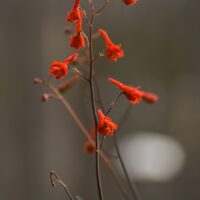
Delphinium nudicaule
In late winter and spring, scarlet flowers with elongated tails perch on upright stalks, usually not more than 3 ft tall. The green, lobed leaves which form a low mound above the ground have a distinctive pale patch in their centers. This native makes its home on summer-dry slopes throughout much of Northern California and parts of Central Ca., inhabiting bright, open woodlands and rocky road cuts. Needs good drainage and little to no irrigation in the summer. While it can grow in a fair amount of shade, it blooms best under a bright, dappled canopy. A favorite of hummingbirds and butterflies. All parts are poisonous if ingested.
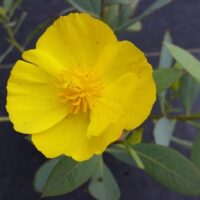
Dendromecon harfordii
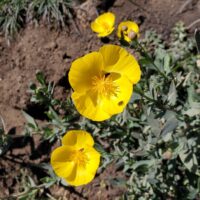
A beautiful and much sought after shrub native to California’s Channel Islands. Growing 6 - 10 ft. tall with bluish-gray foliage and a showy display of brilliant yellow poppy blossoms - spring into early summer, with scattered flowers throughout the year in mild climates. Requires full sun, good drainage, and little to no irrigation once established.
Dendromecon rigida
This is our local bush poppy, growing 4 - 8 ft. tall with bluish-gray foliage and a showy display of brilliant yellow poppy blossoms from spring into early summer. Scattered flowers may be seen throughout the year in mild climates. The leaves are narrower than those of the island bush poppy and the plant has a more open form. Requires full sun, good drainage, and little to no irrigation once established.
Deschampsia cespitosa ssp. cespitosa
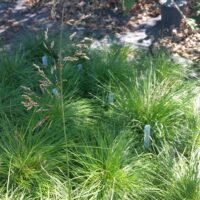
Tufted hairgrass has a large natural distribution, in both the northern and southern hemispheres, in high elevation mountains as well as lower elevations along the coast. The seed for this crop is from coastal Sonoma County, a good choice for low elevation gardens. Forms a deep-green bunch of finely textured blades up to one foot tall with airy flower panicles extending two foot or more above the foilage. Useful framework among wildflowers or with perennials and shrubs. Sun to light shade and a little summer water. Deer resistant.
Deschampsia cespitosa ssp. holciformis
This native bunchgrass makes its home on windswept coastal bluffs from Central CA north to British Columbia. The tidy, evergreen clumps of foliage reach 6 – 12 inches tall and get at least as wide. Stiff, green leaf blades can give plants a spiky appearance, but also make this variety look more symmetrical than many native grasses. The narrow Inflorescences can reach up to 2 ft tall. Does best with full sun near the coast, but enjoys some afternoon shade in hotter areas, where moderate irrigation is recommended. Grows well with iris, seaside daisies and other coastal species. Deer resistant.
Dicentra formosa
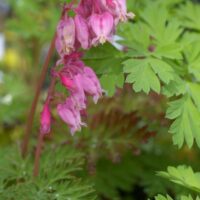
Ferny foliage makes a lacy groundcover in shady areas. Clusters of pendulous, pink, heart-shaped flowers in spring and into summer. Will spread rapidly when happy, enjoying moist but not soggy woodland conditions. Tolerates dry shade where it goes dormant with drought. Early nectar source for hummingbirds and bumble bees. Deer resistant.
Diplacus (Mimulus) ‘Fiesta Marigold’
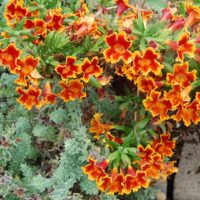
Selected for its large, frilly, brick-red blossoms with orange edging, this striking monkeyflower hybrid comes from horticulturalist Richard Persoff. It is also a relatively compact form at 18 inches to 2 feet tall and wide. Valued for their long bloom season, monkeyflowers perform best with good drainage and sun to light shade. Drought tolerant, but some occasional summer water is helpful. Monkeyflowers benefit from pinching to produce a nice shape and strong structure to hold the abundant blossoms. Highly attractive to bees and hummingbirds. Deer resistant.
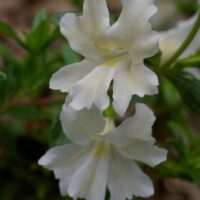
Diplacus (Mimulus) ‘Phil’s White’
The blooms of this monkeyflower hybrid open as a pale ivory-yellow and mature to a cool white. 'Phil's White' is a cross between the lovely White Verity Diplacus (Mimulus) hybrid and Diplacus bifidus from Bowman Lake in the Sierra Nevada (thanks to Ted Kipping). It has proved long-lived in both Fulton and Sebastopol. Foliage is evergreen but benefits from occasional pinching of older stems. This selection has the useful characteristic of sprouting new growth from the base so that old growth can be pruned away. Best with light shade and good drainage. Water occasionally for best blooms. The flowers provide nectar for hummingbirds and butterflies. Deer resistant.
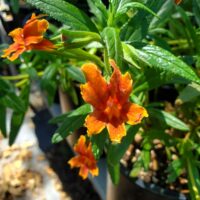
Diplacus (Mimulus) ‘U.C. Hybrid’
A rich-toned hybrid monkeyflower displaying mamalade-orange flowers with contrasting burnished-red throats. Monkeyflowers are 2-3-foot evergreen subshrubs that bloom from spring through summer, and this cultivar is an especially verdant and vigorous form. Does best with good drainage, and prefers afternoon shade inland. Thrives when kept on the dry side with occasional deep summer waterings. Stems can be pinched to form a stronger, denser framework to support its floriferous branches. Hummingbirds, butterflies and bees enjoy the flowers. A larval food source for checkerspot and painted lady butterflies. Deer resistant.
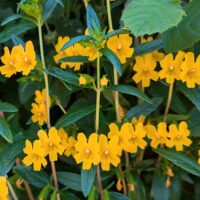
Diplacus (Mimulus) aurantiacus
Sticky monkeyflower is the native monkeyflower species that brightens the hills and coast around Sonoma County. From spring through summer, its profuse yellow-orange tubular flowers decorate evergreen foliage reaching 2-4 feet tall and wide. An unbeatable habitat plant that is highly attractive to hummingbirds. Give it good drainage and keep on the dry side. Thrives in full sun near coast with light shade inland, and benefits from light annual trimming. A larval food source for the common checkerspot and buckeye butterflies. Deer resistant.
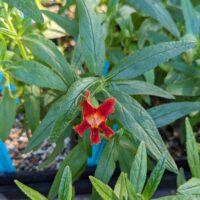
Diplacus (Mimulus) longiflorus
Hummingbirds love the abundant deep red flowers of this stand-out monkeyflower. Hailing from Southern California and growing 2 -3 ft. tall, and at least as wide, this drought-tolerant, floriferous shrublet blooms late spring into fall. Plant in sun to light shade with good drainage and occasional summer water. Besides hummingbirds, other pollinators will be attracted to the flowers, and the foliage is used by checkerspot and painted lady butterfly larvae. Deer resistant.
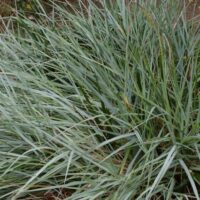
Elymus (Leymus) condensatus ‘Canyon Prince’
A beautiful selection from the Channel Islands off Southern California. Distinctive for the lovely, broad, silver-blue blades 2 1/2 to 3 ft. tall with wand-like grass flowers reaching up to 2 feet above the foliage. Accepts sun to very light shade and moderate to little water. Tolerates heavy soil. Spreads by rhizomes to form striking silver drifts, but is vigorous and aggressive. Best to use where a large patch is desired or where it is contained, such as a parkway strip. Cut back in winter to rejuvenate and remove old leaves. Drought and deer resistant.
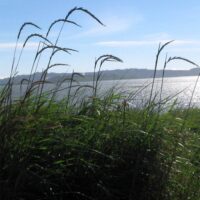
Elymus (Leymus) triticoides
Spreading, turf forming, perennial grass found in somewhat moist areas in many plant communities throughout California. An important restoration species, useful for holding soil and enhancing wildlife habitat value. Growing 2-4 ft. tall and spreading widely with an extensive network of rhizomatous roots which both hold soil and help prevent exotic weed establishment within their dense mats of roots and foliage. Slender blue-green blades are topped with narrow flower spikes 4-6 inches long. Excellent for seasonally moist bottom land and riparian areas where it can grow in full sun to light shade and tolerates many soil types. Will tolerate some drought in heavier soils. May spread too vigorously for small gardens.
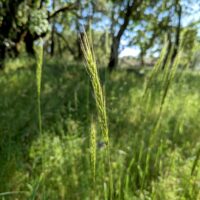
Elymus glaucus
A stiffly upright, clump-forming grass with blue-green blades, native to much of the western U. S.. The flowers form bristle-tipped, narrow, vertical spikes, rising 2-4 feet tall. Easy to grow and a strong reseeder for full sun to light shade. Summer water keeps plants green longer, but will go dormant with drought. This very adaptable grass is excellent for bank stabilization in challenging soils. Deer resistant.
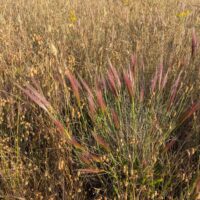
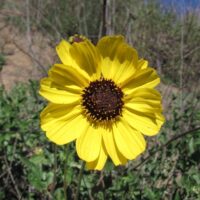
Encelia californica
Cheery yellow daisies with purplish-brown centers cover this sunflower from late winter all the way into summer, making it one of our longest blooming natives. The 2-inch-wide blossoms make for stupendous cut flowers and are loved by bees and butterflies. Goldfinches enjoy the seeds which follow. This somewhat short-lived subshrub features dark green, diamond-shaped leaves and reaches about 3 – 4 ft. tall, spreading a little wider. Should reseed if the spent flowers aren’t removed. Enjoys full sun to light shade and occasional to infrequent irrigation with decent drainage to look its best. Native to generally coastal areas in southern California. While not especially cold sensitive, it will freeze if the temperature gets down to the mid 20s.
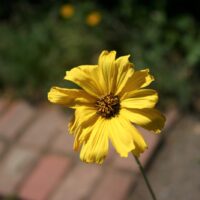
Epilobium ‘Bert’s Bluff’
A Las Pilitas Nursery selection, named for the founder, Bert Wilson. This California fuchsia sports grey foliage, growing 2 -3 foot tall and spreading. Blooming in late summer, the bright orange-red, tubular flowers are beloved by hummingbirds, but visited by bees as well. This cultivar is reputed as being particularly tolerant of a wide range of soil conditions and growing environments. Plant in full sun with occasional deep summer watering.
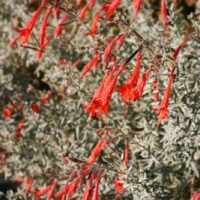
Epilobium ‘Chaparral Silver’
This California fuchsia that we obtained from another grower appears to be identical to our ‘Roger’s U. C. Hybrid’ - same lovely gray foliage 12 -18 inches tall, spreading, with narrow red tubular flowers that the hummingbirds love. Provide full sun to bright shade. Flowers best with occasional deep watering. Pruning plants down to a few inches in late autumn helps to rejuvenate them for the following year.
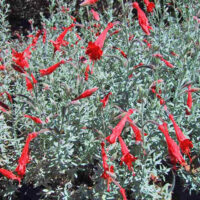
Epilobium ‘Roger’s U.C. Hybrid’
A California fuchsia that is upright in habit with narrow silver-gray foliage and slender trumpet-shaped blossoms of orange-red. Reaches a height of about 1 1/2 ft. and spreads easily. Very similar to the selections ‘Carman’s Gray’ and ‘Chaparral Silver’. Flowers best with occasional deep watering. Hummingbird favorite. Pruning plants down to a few inches in late autumn helps to rejuvenate them for the following year.
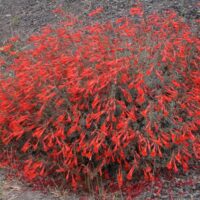
Epilobium ‘Schieffelin’s Choice’
This California fuchsia grows close to the ground - 10 - 12 inches tall with arching flower stalks. Gray foliage makes a wonderful foil for the bright orangey-red tubular flowers which appear summer through fall. Believed to be a cross between E. septentrionale and E. canum. Provide full sun to very light shade. One of the more drought tolerant selections but flowers best with occasional deep watering. Hummingbird favorite. Pruning plants down to a few inches in late autumn helps to rejuvenate them for the following year. Perhaps more deer resistant than other California fuchsias.
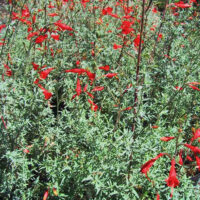
Epilobium canum ‘Bowman’s Hybrid’
This California fuchsia has distinctive narrow, olive-green foliage and an upright habit about 2-3 ft. tall and spreading widely. The orange-red tubular flowers are petite but profuse. Plant in sunny areas. Flowers best with occasional deep watering. Pruning plants down to a few inches in late autumn helps to rejuvinate them for the following year. Hummingbird favorite.
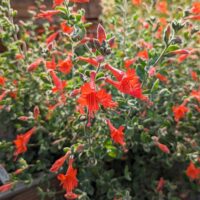
Epilobium canum ‘Calistoga’
Phil Van Soelen’s selection of California fuchsia from the Palisades east of Calistoga. Forms a spreading mat of unusually wide, fuzzy, gray leaves. The flowers are the typical hummingbird attracting orange-red trumpet shape and appear on stalks reaching up to 18 inches high. For sunny areas. Flowers best with occasional deep watering. Pruning plants down to a few inches in late autumn helps to rejuvenate them for the following year.
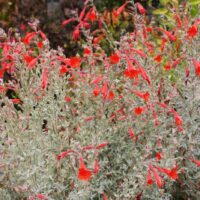
Epilobium canum ‘Carman’s Grey’
We love California fuchsias and have grown this cultivar for over twenty years. Valued for their beauty and important late season nectar source for hummingbirds, California fuchsias offer many forms and foliage colors. 'Carman's Grey' has gorgeous grey foliage which contrasts beautifully with the masses of orangey-red, tubular flowers, late summer and fall. The grey, narrow leaves form soft mounds 2 foot tall, spreading by underground rhizomes, 4 foot or so wide. Plant in full sun to very light shade where it is tolerant of many soil types, even heavy clay, drought tolerant, but best with occasional summer watering. Hummingbird magnet and bees use it too.
Epilobium canum ‘Catalina’
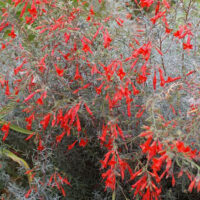
An outstanding selection of California fuchsia growing 3 ft. tall or more. This may be the tallest cultivar available, sometimes reaching as much as 5 ft. tall. The foliage is silvery-gray with an abundance of large, brilliant orangey-red tubular flowers late summer through fall. This species from southern California is particularly drought tolerant. Hummingbird favorite. Flowers best with occasional deep watering. Pruning plants down to a few inches in late autumn helps to rejuvenate them for the following year.
Epilobium canum ‘Cloverdale’
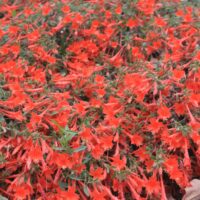
This form of California fuchsia was selected by U.C. Santa Cruz Arboretum from along the Russian River north of Cloverdale. Low, slightly mounding fuzzy olive-green foliage with an abundance of orangey-red tubular flowers the hummingbirds love. Usually stays bellow one ft. in height. 'Cloverdale' is one of the most orange selections of California fuchsia. Plant in full sun. Flowers best with occasional deep watering. Pruning plants down to a few inches in late autumn helps to rejuvenate them for the following year.
Epilobium canum ‘Coral Canyon’
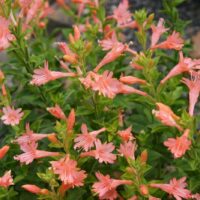
This elegant and unusual form of the California fuchsia offers a prolific display of peachy-pink flowers, a departure from the more common orangey-red blossoms. The late-summer, autumn blooms are held on distinctly upright stems reaching 1 ½ ft. high above broader, bright green foliage. Unlike most native fuchsias, this selection is somewhat shy to spread, generally forming a rounded mound about 2 ft. wide. Enjoys full sun, but will benefit from a little afternoon shade in hot areas. Likes moderate to occasional irrigation. Hummingbirds and bees partake from the flowers. We must thank Cistus Nursery for discovering the parent plant on a high ridge above the North Fork of the American River.