
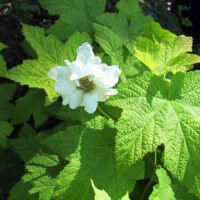
Rubus parviflorus ‘Dr. Stasek’
Bob Hornback found this interesting form of thimbleberry. Instead of the usual single white flowers, this cultivar offers double flowers. The extra petals are a nice touch against the background of large velvety leaves. Thimble-shaped edible berries follow which are mild flavored but sweet and much enjoyed by birds. Grows 3 - 6 ft. tall and spreading. Needs part shade and moisture.
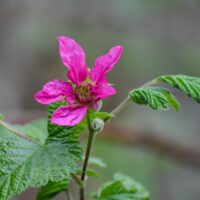
Rubus spectabilis
Native to moist places in and about the woods of coastal Northern California. Forms an upright shrub that arches at the tips, growing easily 6 ft. by 6 ft. Dark green foliage with weak prickles can form a dense hedge. The dark pink flowers resemble small single rose blossoms and are followed by showy orange-red berries that look like salmon eggs. Wildlife relishes the fruit, people too, though they aren’t as tasty as blackberries. Grows best with summer water and some shade.
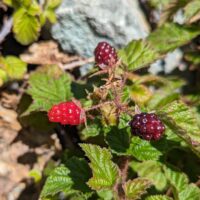
Rubus ursinus
Not to be confused with the weedy non-native Himalaya berry that has taken over acres in northern California. The native blackberry when happy can form a good sized patch, growing to about 3 ft. tall and spreading more than 6 ft. wide depending on available moisture. This thorny, spreading evergreen has excellent habitat value. The berries are widely used as a food source for wildlife. Offers excellent escape and nesting cover and is good for erosion control. People relish the berries and its fruits are highly prized for pies and jam. Best with some shade and moisture, but is drought tolerant once established.
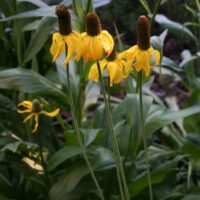
Rudbeckia californica
Large, bold perennial native to montane seeps and meadows where they receive regular moisture. The big leafy clumps can become very large growing 3 foot tall or more. Midsummer brings showy yellow daisies on tall stems with a distinctive long central cone and a skirt of three inch yellow petals. Plant in sun to light shade with regular water. Highly attractive to bees and other pollinators.
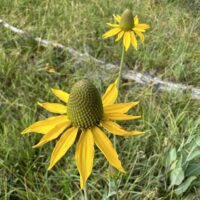
Rudbeckia glaucescens
This uncommon coneflower hails from the Klamath Mountains of northern California and southern Oregon. While similar in flower to the California coneflower, featuring yellowish-brown cones encircled with a skirt of long, yellow petals, this species has waxy leaves tinted a striking blue-gray. The flowers perch atop leafless stalks reaching 3 to 4 ft tall, rising above the large, lance-shaped leaves. A favorite of bees and butterflies. Even though this species normally occurs in serpentine soils, it grows easily in almost any soil type, as long as it is kept moist. Enjoys regular to moderate irrigation and full sun to part shade.
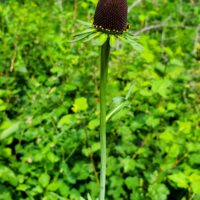
Rudbeckia occidentalis
From mountains in Northern California and throughout the West comes this unusual and distinctive coneflower. Deep purple, almost black cones sit atop a star of green sepals without any petals to distract from the striking form. Large, pointed green leaves climb up the flowering stems which can reach 5 or 6 ft. high. Slowly spreads to form a small clump in moist locations with decent drainage. Will tolerate full sun near the coast, but some afternoon shade is needed in hot, inland areas. An excellent pollinator plant from the sunflower family attracting bees and butterflies. Works well in a container. Winter deciduous.
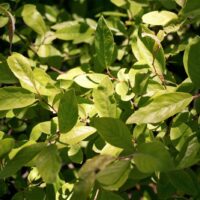
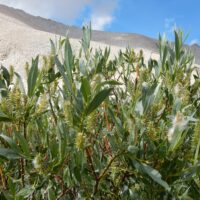
Salvia ‘Aromas’
A hybrid between Salvia clevelandii & Salvia leucophylla, this aromatic shrubby sage grows 4 ft. tall and 4 ft. wide. Early summer brings flower stalks with whorls of lavender-blue blossoms. Good for sunny areas with good drainage. Occasional to little summer water. Flowers are attractive to bees, hummingbirds and butterflies. Deer and drought tolerant.
Salvia ‘Bee’s Bliss’
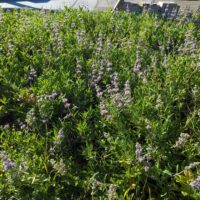
A beautiful native hybrid sage grows around 18 inches tall by 6 ft. wide or more. The handsome gray foliage is topped with a profusion of lavender flowers on long spikes in the spring. Sun, decent drainage, occasional to little water. Deer tolerant. A bee and hummingbird favorite.
Salvia ‘Calamity Jane’
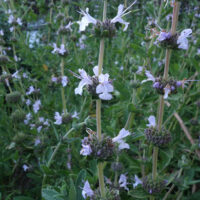
A cross between Salvia leucophylla and a prostrate form of Salvia mellifera. Forms a fragrant mounding shrub up to 4 ft. tall and spreading, with flower spikes of light lavender blossoms. An excellent choice for a dry sunny bank with little to no summer water once established. Flowers are highly attractive to bees and hummingbirds. Deer resistant.
Salvia ‘Celestial Blue’
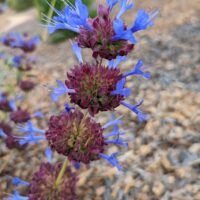
A pollinator powerhouse, this sage attracts hummingbirds, bees and butterflies with its vibrant blossoms. Selected and introduced by Las Pilitas Nursery, thought to be a hybrid between Salvia clevelandii and S. pachyphylla, or perhaps a three way hybrid involving Salvia 'Pozo Blue'. Gray-green, sweetly fragrant foliage, grows 3 to 5 ft. tall and wide. The striking blue flowers are on widely spaced whorls of eye-catching violet-blue. The decorative, architectural seed heads that follow provide food for songbirds. Plant in full sun with good drainage and occasional water. Drought and deer tolerant tolerant.
Salvia ‘Mrs. Beard’
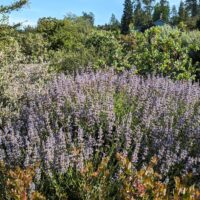
This cultivar has been around since 1965, a chance seedling discovered in a Berkeley garden. A hybrid between Salvia sonomensis and Salvia mellifera, 'Mrs. Beard’ has proven durable and disease resistant. Forms a dense mat of gray fragrant foliage up to 2 ft. tall and 4-6 ft. wide. Spring brings an abundance of tiny pale lavender-blue flowers in ball-like clusters that are highly attractive to bees and hummingbirds. Plant in full sun along coast and light shade in hot inland sites, where it will be quite drought tolerant once established. Deer resistant.
Salvia ‘Shirley’s Creeper’
A vigorous garden hybrid involving the native Salvia mellifera selected by Charlie Christiansen. The cultivar name is misleading. This shrub does not creep exactly but mounds up 4-6 ft. tall and wide. It can be kept lower and more dense by an annual cutting back after flowering. Dark green aromatic foliage is a nice foil for the whorls of white flowers in the spring which are a favorite of bees and hummingbirds. Plant in full sun to light shade. Very drought tolerant once established. Dependably deer resistant.
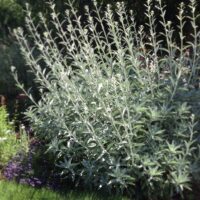
Salvia apiana
A striking native sage with large, silvery-white, aromatic leaves and tall flower stalks reaching above the foliage displaying lavender tinged white blossoms. The foliage of this shruby sage reaches 3 - 4 ft. tall with flowering stalks adding another 2 ft. or more above that. A useful plant for sunny, dry areas with good drainage. Combine with dark-leaved plants such as ceanothus and manzanitas to create a dramatic display. Used in smudge bundles as a natural incense. A bee and hummingbird favorite. Deer resistant.
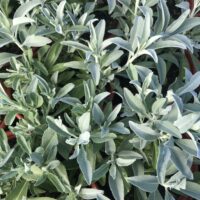
Salvia apiana ‘Compacta’
Having all the attributes of white sage, but growing about half the size, topping out at around 3 ft. tall. Gorgeous silver-gray foliage and stately flower stems of white, pollinator attracting blossoms. Heat and drought tolerant, this striking sage makes a wonderful specimen and contrasts beautifully with greener foliage. Plant in full sun with good drainage where it thrives with summer heat and drought. The powerfully fragrant foliage is dependably deer resistant.
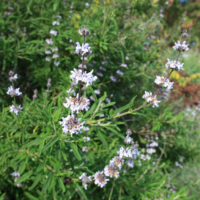
Salvia brandegeei
Native to Southern Spain and North West Africa, this herbaceous perennial spends much of the growing season as a low mound of gray-green wavy leaves. Early summer, tall flower stems rise 3 - 5 feet, with branched spikes of lovely light lavender-blue blossoms, that last about one month. Cut down old spikes or allow to go to seed for future propagation. Plant in sun with good drainage and moderate summer water. Pollinators of all sorts love sages.
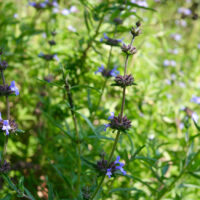
Salvia brandegeei ‘Pacific Blue’
A very nice form of a tough and durable native shrubby sage introduced by Santa Barbara Botanic Garden. Growing 4-6 ft. tall and wide with dark green textured foliage with white hairs on the leaf undersides. Instead of the typical light lavender flowers, this cultivar offers dark lavender-blue blossoms. Plant in full sun with little to no summer water once established. This native sage seems very tolerant of soil types even managing on heavy clay. Sage flowers attract bees, butterflies and hummingbirds, their seeds provide food for birds. Deer resistant.
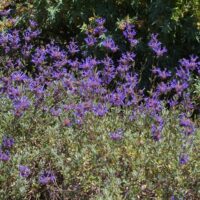
Salvia clevelandii ‘Winnifred Gilman’
Floriferous native shrubby sage prized for its intense violet-blue flowers and sweetly fragrant foliage. ‘Winnifred Gilman’ has a nice compact habit to around 3 ft. tall. Well suited for sunny areas with good drainage and occasional summer water. Deer and drought tolerant; attracts bees and hummingbirds.
Salvia clevelandii x ‘Allen Chickering’
Delightfully fragrant hybrid sage between S. clevelandii and S. leucophylla. Blue lavender flowers in whorls during summer. Grows 3 - 5 ft. tall and wide. Good for dry sunny areas. Attractive to hummingbirds, bees and butterflies. Deer resistant.
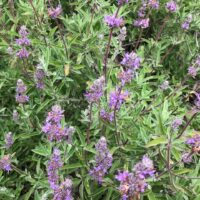
Salvia clevelandii x ‘Kaleidoscope’
This striking new introduction features rosy-purple flowers in whorls atop dense, grey foliage. ‘Kaleidoscope’ is a nice and compact sage, only reaching to 2 – 3 ft. high and slowly spreading to form a small drift about 4 ft. wide. It is proving to be quite a garden tolerant Salvia and resistant to disease, though we are still evaluating it. Enjoys full sun and occasional to no irrigation once established. Needs decent drainage. An excellent plant for bees and butterflies. This selection was discovered by Terry Loveton in her west Sonoma County garden. Deer resistant.
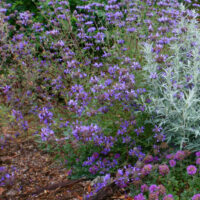
Salvia clevelandii x ‘Pozo Blue’
This hybrid of Salvia clevelandii and Salvia leucophylla was selected by Las Pilitas Nursery and is getting very good reviews. It appears to be a good substitute for Cleveland sage tolerating less than perfect soil conditions and colder low temperatures. Growing 3-5 ft tall and wide with gray-green fragrant foliage. Blue-lavender flowers in ball-like clusters top the shrub in late spring through early summer and are highly attractive to bees, butterflies and hummingbirds. Best in full sun with decent drainage. Drought tolerant once established. Deer resistant.
Salvia clevelandii x ‘Whirly Blue’
Large native sage growing 4.5 - 6 ft. tall and wide with aromatic gray-green foliage and rich violet flowers. Very large flower whorls and deeper color distinguish it from Salvia ‘Aromas’ and Salvia ‘Allen Chickering’. Good for dry sunny areas. Deer resistant. Attractive to hummingbirds, bees and butterflies.
Salvia greggii ‘Furman’s Red’
Selected in the 1970’s and a Plant Select winner in 2005, this dependable selection persists in the trade for its profuse displays of dark-red flowers and cold tolerance. Growing 3 to 4 feet tall and 2 to 3 ft. wide with light-green, aromatic foliage. The magenta blossoms can bloom spring through fall and attract hummingbirds, butterflies and other pollinators. Prefers full sun with decent drainage and is drought tolerant once established. Deer resistant.
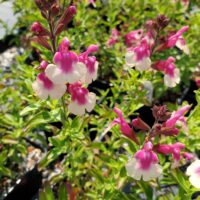
Salvia greggii ‘Mirage Rose Bicolor’
Top winner at the Welby Flower Trials in Colorado, this hybrid sage was bred for long blooming and heat tolerance. Compact and tidy, growing 12 -14 inches tall and a bit wider. The fragrant foliage is topped with a profusion of nectar-rich, two toned flowers of deep rose-pink and creamy-white, summer into fall. The appealing, bold display attracts hummingbirds, butterflies and bees. Plant in full sun to light shade with moderate to occasional water. Makes a good container subject. Deer resistant.
Salvia greggii ‘Radio Red’
This new cultivar of autumn sage offers larger, vivid red flowers and a more compact habit. Despite it's common name, autumn sage blooms over a long period, beginning in late spring, into summer and through autumn. Well branched shrubby habit with neat, fragrant foliage growing 2 - 3 foot tall and wide. Can be grown as a single specimen, lightly clipped as a low, informal hedge or in a container. Plant in full sun with moderate to occasional summer watering. The true, bright red flowers are highly attractive to hummingbirds as well as bees and butterflies. Deer resistant.
Salvia greggii ‘Smokin’ Lavender’
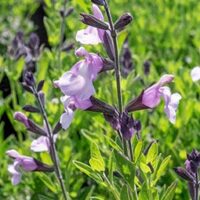
Yet another cultivar of autumn sage, a sturdy and floriferous perennial, native to the southwest U.S. and Northern Mexico. A great addition to the pollinator garden where it provides copious nectar to bees, butterflies and hummingbirds throughout the summer and fall. A compact evergreen with aromatic foliage, growing about 2 ft tall and wide. Soft, lavender blossoms emerge from dark purple calyces and bloom freely over a long period. Plant in full sun to very light shade with moderate to occasional watering once established. Good container plant. Deer resistant.
Salvia leucophylla
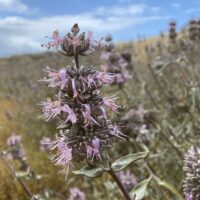
Purple sage is a highly-aromatic shrub, native to coastal scrub and chaparral from the Big Sur to San Diego. This delightful and dependable salvia boasts lavender-pink floral whorls arranged along spike-like stems. In summer, the spent flower stalks retain attractive showy bracts, good for seasonal interest and seeds for birds. The foliage has a mounding habit with soft-green-to-silvery leaves. This species generally reaches 3-5 ft tall and considerably wide, but some popular cultivars range from more upright to a 2-foot spreading groundcover. Easy to grow in full sun with occasional-to-infrequent water. A great choice for a sunny bank. Deer resistant.