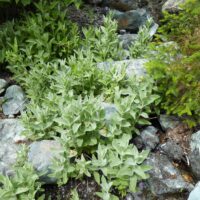
Salvia pachyphylla
Native to southern California deserts, this beautiful silvery shrub of intensely aromatic foliage grows 18 - 30 inches tall and wide. Spikes of densely packed violet whorls support elongated blue flowers, blooming over a long period in summer. This striking sage requires full sun with excellent drainage, where it will be extremely drought tolerant once established. A magnet for pollinators including butterflies and hummingbirds. Deer resistant.
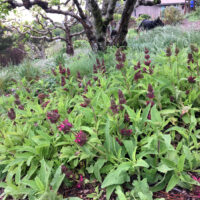
Salvia spathacea
A wonderful native sage, endemic to California where it is found at low elevations of the Coast Ranges from San Bruno Mountain in the north to Orange County in the south. Fragrant, fruity foliage spreads by creeping rhizomes to form handsome mats. Flower stems rise 2 - 3 ft. above the leaves carrying many large ball-like clusters of magenta flowers that the hummingbirds adore. Does best in cool sun or part shade in hot areas. Drought tolerant, but looks best with occasional summer water. This species attracts hummingbirds. Deer resistant.
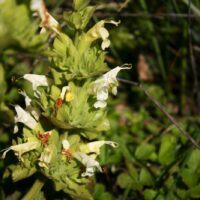
Salvia spathacea ‘Avis Keedy’
An striking yellow-flowered form of the normally magenta-flowered hummingbird sage, introduced by the Santa Barbara Botanic Garden. Discovered in an oak woodland in Santa Barbara County, this cultivar has unusual lemon yellow petals that fade to creamy white and are backed by lime green bracts. Forms the usual fragrant, spreading mat of large leaves topped with 2-3 foot tall flower stalks with distinctive whorls of flowers in the spring. Best with part shade unless directly along the coast and an occasional summer watering to keep it going through the summer. Without summer water will go summer dormant reviving with the rains. A bee and hummingbird favorite. Deer resistant.
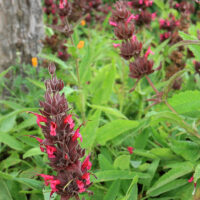
Salvia spathacea ‘Las Pilitas’
A very LOW form of the fragrant hummingbird sage, selected and introduced by Las Pilitas Nursery. Ground hugging foliage spreads to form handsome mats 3 - 6 ft. wide. Flower stems rise 18 inches above the foliage with ball-like clusters of magenta flowers which are bee and hummingbird favorites. Best with light shade and occasional summer water. Deer resistant.
Salvia spathacea ‘Powerline Pink’
This selection of the wonderful native hummingbird sage is notable for its size. It stands 2 ft. tall before it flowers, and its flowering stalks can add another 2-3 ft. to the height. Fragrant, fruity foliage spreads by creeping rhizomes to form handsome mats. The flower stems carry many large ball-like clusters of magenta flowers that the bees and hummingbirds love. Does best in cool sun or part shade in hot areas. Drought tolerant but looks best with occasional summer water. Deer resistant.
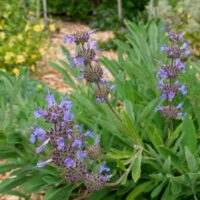
Salvia x ‘Dara’s Choice’
Selected by Santa Barbara Botanic Garden, this native hybrid sage forms a dense, dark green, mounding groundcover 1.5-2 ft. tall by 3 – 5 ft. wide. The aromatic foliage is topped with wands of soft lavender-blue flowers on small whorls in the late spring to early summer. In hotter climates, light or part shade is preferred, where it will be quite drought tolerant once established. A more refined native sage which combines well with iris, California fuchsia and grasses. Adored by bees and hummingbirds but not eaten by deer.
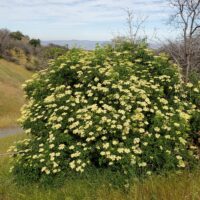
Sambucus mexicana (nigra ssp. caerulea)
Our native blue elderberry, often seen on banks above rivers and streams, or even on somewhat drier slopes. A fast growing deciduous shrub or small tree 8 to 30 ft. tall with pinnately divided leaves. Creamy yellow flowers appear in late spring in flat-topped clusters, followed by blue berries. High on the birds’ favorite list! Ripe berries feed many species of birds. Moderate to infrequent summer water.
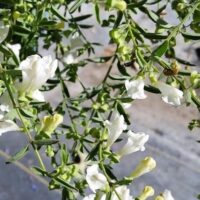
Scutellaria californica
A charming perennial native to gravelly soils of low and mid elevation mountains of Northern California where it grows on the edge of woodlands and chaparral communities. Leaves are arranged oppositely on erect stems around one foot tall. The very sweet, small, creamy-white snapdragon-like flowers occur in pairs at the leaf axils. Spreads by underground rootstocks to form colonies. In our nutritious, water-retentive soils has spread quite vigorously, in dryer leaner soils less so. Plant in full sun to light shade. Drought tolerant but would appreciate a little summer water.
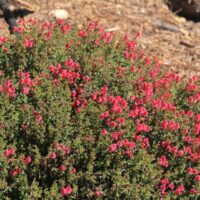
Scutellaria suffrutescens
Sturdy, compact, long blooming perennial growing less than 6 inches tall by 15 inches wide. Deep green foliage and dense growth habit make a tidy foil for the profusion of small rosy- pink snapdragon-like flowers over a long period spring-summer. Highly attractive to pollinators and hummingbirds. Plant in full sun to light shade with occasional water. Drought and heat tolerant. Deer tolerant too.
Sedum divergens
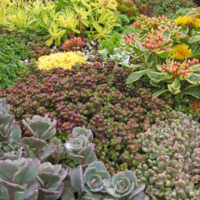
This is a little beauty. Mat-forming and evergreen, this succulent is native to California north to Alaska. Tolerant of wet winters, the shiny round bead-like leaves turn a dark red in full sun. Stays compact and slowly spreads, 2 - 4 inches tall, reaching about 18 inches in diameter. Blooms starry yellow flowers in summer. Great in rock gardens, planters, useful as an edge plant. Adapts to many soil types. Fully hardy and drought tolerant once established. We have this planted in our trough in front of the greenhouse.
Sedum spathulifolium ‘Cape Blanco’
A mat forming, western native succulent, often seen on rocky cliffs and shady banks in California’s Coast Ranges and Sierra Nevada north to British Columbia. Small, spoon-shaped leaves form flat rosettes where bright yellow star-like flowers appear in late spring and early summer. The cultivar 'Cape Blanco' was selected along the Oregon coast, for its chalky-white foliage. A natural for the rock garden or container plantings where they are best with part shade. Very drought tolerant.
Sequoia sempervirens
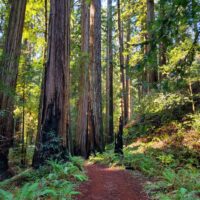
A beautiful and fast growing conifer, famous, as it is the world’s tallest tree. Outside its native range or in a garden setting, it provides a symmetrical pyramid of soft fragrant foliage 70 to 150 ft. The columnar trunks are covered with thick fibrous red-brown bark. Small one inch cones form in clusters at the branch tips. Grows easily in areas with coastal influence and fog but will grow in drier interior sites with regular summer water. Performs well in the regular watering regimes of many urban gardens and lawns. Can be planted as a specimen, in groves, or even pruned as a hedge. As long as its watering requirements are met it has very few pest or disease problems.
Sequoiadendron giganteum
This iconic Californian giant hales from the west side of the Sierra Nevada where it forms dramatic cathedrals with its massive, cinnamon-colored trunks. The leaves are gray-green and scale-like, hugging the billowing stems. In nature, this close relative of the coast redwood can be over 3,000 years old and reach over 300 ft. tall with trunks bulging to 56 ft. in diameter. In a garden setting you can expect a more reasonable height of 60 – 90 ft. with a canopy spread of around 40 ft. A stunning specimen tree for a large garden. Needs decent drainage and occasional irrigation when young, though it will become quite drought tolerant once established. Full sun to light shade. More cold hardy and drought tolerant than the coast redwood. Reported to be deer resistant.
Sidalcea malviflora
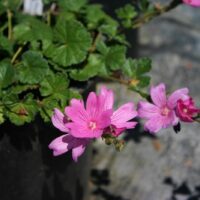
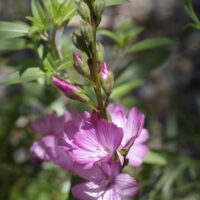
Beautiful spring blooming native perennial found in moist meadows along the coast and inland from Southern Oregon to the Mexican border. Reliable and easy to grow, and an excellent addition to a grasslands or meadow planting. Grow in full sun to partial shade where it thrives with moisture and tolerates moderate to little water once established. With drought will go summer dormant. Light to dark pink, small to large flowered; they are all beautiful. A nectar and larval food source for the West Coast Lady, Painted Lady, Common Checkered Skipper, and the Gray Hairstreak butterflies.
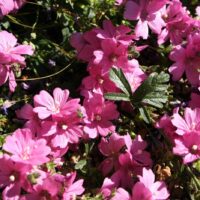
Sidalcea malviflora ‘Palustre’
This selection of our native checkerbloom has particularly large, saturated pink flowers held on stems which spread across the ground. Leathery, dark-green, scalloped leaves form a carpet on this small-scale groundcover. Plant in full sun to light shade and provide moderate irrigation. Butterflies nectar on the flowers and also use checkerbloom as a larval host plant. West Coast lady, painted lady, checkered skipper and gray hairstreak butterflies all depend on this species to support their caterpillars.
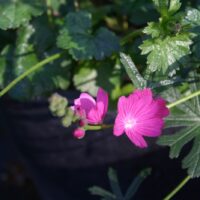
Sidalcea malviflora ssp. patula
Bright, rose-pink flowers line foot long stems on this rare checkermallow from northwest California. Spreading mats of fuzzy, round leaves provide an appealing backdrop for the colorful flowers. Enjoys full sun to part shade. Protect from the hot afternoon sun in inland climates. Provide moderate to occasional irrigation. An excellent plant for bees and butterflies.
Sidalcea malviflora ssp. virgata
This beautiful, perennial mallow can be found in grasslands, meadows, and roadsides of Oregon. Forms a low rosette 1 to 2 ft. wide with trailing branches and rounded, lobed leaves. The showy, hollyhock-like flowers are arranged on upright spikes, ranging from light to deep pink and bloom for a long period beginning in late spring. Plant in full sun to light shade with moderate to occasional water once established. Lovely in meadow plantings with other perennials, bulbs and grasses. An important nectar source for bees, butterflies and other beneficial insects and a host plant for several butterfly species.
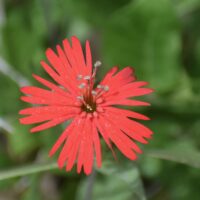
Silene laciniata ssp. californica
Native to open woods from Southern California north to Oregon, this native perennial is a knock out in bloom. Late spring and early summer bring brilliant, deeply lobed scarlet petals over the low growing mound of foliage 1-2 feet tall and about as wide. Best suited for well drained soils in lightly shaded settings where water can be withheld once plants begin to go dormant. A top notch rock garden subject and hummingbird favorite.
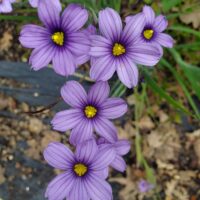
Sisyrinchium bellum
A beloved native perennial wildflower with grass-like foliage and six-petaled spring blossoms that range from blue to purple with occasional pure white forms. Grows 6 - 12 inches tall in small clumps where it is useful in meadow or grassland plantings as well as mixed borders. Sun to partial shade, with moderate to infrequent summer water. Goes summer dormant in dry gardens. Does well in heavy soils and often seeds about when happy.
Sisyrinchium bellum ‘Dwarf’
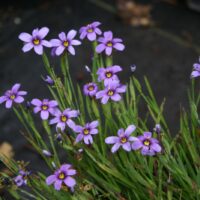
While we’re a little unsure about this selection’s origins, we do know it’s an AMAZING bloomer and an easy garden plant! In spring and into summer, deep blue-purple flowers with yellow centers cover this very dwarf blue-eyed grass which stays under 6 inches tall. Very narrow, iris-like leaves slowly increase to form a small clump. Plant in full sun to light shade and provide moderate to infrequent irrigation. If allowed to go dry in summer, it will go dormant, only to re-emerge with the winter rains. Deer resistant.
Sisyrinchium bellum ‘Rocky Point’
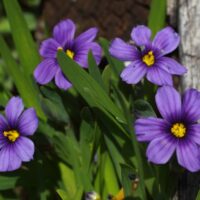
A vigorous selection of dwarf blue-eyed grass discovered on Rocky Point south of Carmel in Monterey County and introduced by Native Sons Nursery. Robust, rich green clumps of wide, iris-like leaf blades 4 - 6 inches tall feature vibrant blue-purple flowers with yellow centers. A great rock garden item. Plant in full sun to part shade. This spring bloomer will go semi-dormant in summer if allowed to go somewhat dry. With moderate irrigation it will be evergreen and have an extended bloom preiod. Deer resistant.
Sisyrinchium bellum ‘Stripey’
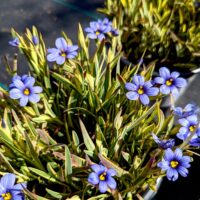
An eye-catching cultivar of blue-eyed grass, forming compact clumps of narrow variegated foliage. The gray-green blades have pale yellow margins growing around 6 inches tall and a foot or so wide. The chubby clumps of narrow, variegated leaves are topped with cool blue flowers in the spring. Perfect rock garden item or container accent for sun to light shade with moderate water. Deer resistant.
Solanum xanti ‘Mountain Pride’
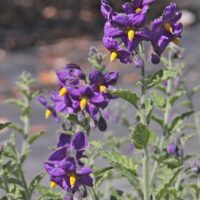
Outstanding selection by Carol Bornstein from the hills surrounding Santa Barbara,following the wildfires of 2008. Chosen for its particularly dark purple flowers, this subshrub grows 3 ft. tall and at least as wide. Clusters of rich purple one inch blossoms with bright yellow stamens bloom over a long period but heaviest in spring. In nature it is often found growing along the borders of coastal scrub,chaparral and woodlands. Plant in full sun along the coast with a little shade inland, where it will be drought tolerant once established. Prune to promote bushy habit. A good container subject. Should be deer resistant as all parts of the plant are poisonous.
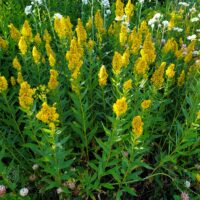
Solidago lepida v. salebrosa
Golden-yellow, pyramid shaped inflorescences sit atop stems flanked with bright green leaves on this unusual native goldenrod. This selection is more compact and refined than the California goldenrod, with flower stalks reaching only about 2 feet tall and a spreading habit which is less aggressive. A superb plant to attract all sorts of bees and butterflies when it blooms in late summer and into autumn. Plant in full sun to light shade and water moderately to occasionally. This variety grows throughout western North America but is rare in California, only occurring in the northeast part of the state.
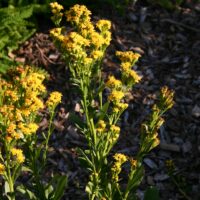
Solidago spathulata
Native to coastal strand and coastal scrub communities where it forms low mats of spreading bright green foliage. Summer brings flower stems a foot or so tall made up of small bright golden-yellow daisies. Full sun to light shade with some summer water. Tolerates heavy soils. The flowers support native bees, honey bees, beneficial insects and butterflies. It is a larval food source for the northern checkerspot butterfly.
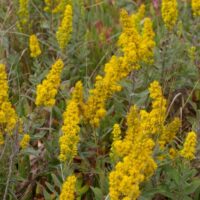
Solidago velutina ssp. californica
A showy and easy to grow late blooming native perennial. Spreads by creeping rootstocks where it can form a good-sized colony. Has spread slowly in our heavy clay soils with minimal water, but has the potential to spread aggressively in lighter soils especially with regular water. Late summer through fall brings slender wand-like flower stalks of golden yellow daisies 2 - 3 ft. tall which are visited by bees, butterflies and other insects. Plant in a sunny area where it is drought tolerant, but some supplemental summer water keeps it blooming longer.
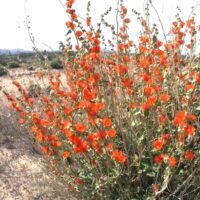
Sphaeralcea ambigua
Native to desert plant communities, apricot mallow is a showy evergreen shrublet growing 2-4 foot tall and wide. Soft-green, woolly, scalloped leaves provide the foil for long wands with an abundance of small hollyhock-like flowers in delicious shades of orange. Plant in full sun with good drainage and occasional summer water. Adaptable, tolerating cold, dry conditions but not heavy wet soils. When happy can bloom for months- trim back flowering stems after bloom for repeat performance. A beautiful addition to the dry sunny garden, ideal for inland gardens. Relatively short lived but grows rapidly and occasionally reseeds. Honeybees, native bees and hummingbirds are attracted to its flowers.
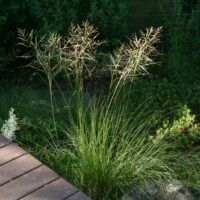
Sporobolus airoides
A robust, warm season bunchgrass, which was common in California’s Central Valley prior to agricultural conversion. This western native is found in the Sierra foothills, South Coast Ranges as well as deserts from eastern Washington to Mexico. Forms a dense bunch of fine textured, grey-green blades, on average 3 foot tall and wide. Graceful flowering stems carry airy, pinkish flower heads that produce a pink-hued haze, which age to tan. The abundant seeds are relished by birds, but do not tend to reseed in gardens. Tolerant of many soil types and water regimes. Best with full sun to light shade. This grass will be drought tolerant, but does best with some summer water in dryer inland sites. Leaves turn butter-yellow in autumn prior to winter dormancy. Deer resistant.