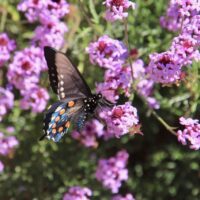
Verbena lilacina ‘De La Mina’
Verbena lilacina ‘De La Mina’ delights with dense clusters of rich lavender blossoms that are highly attractive to butterflies. Can bloom nearly year round along the coast, spring through fall elsewhere. Native to Cedros Island off of Baja, Mexico, ‘De La Mina’ was selected by the Santa Barbara Botanic Garden for its darker shade of lavender flowers. Generally cold-hardy to 25°F, the deliciously aromatic, evergreen foliage may need light trimming when subject to winter frost or extreme heat. Forms a lacy mound 1-2 ft. tall and 2-4 ft. wide. Plant in full sun with moderate to occasional summer water. Makes for an excellent border or container plant, and is reportedly deer resistant.
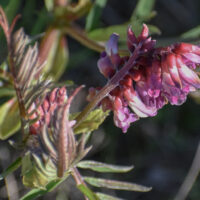
Vicia gigantea
This native pea-relative is a climbing perennial with delicate, arching clusters of magenta flowers. Leaves are dense rows of narrow leaflets culminating in tendrils that help it vine over shrubs, fences or up trellises. With its slender but vigorous stems, giant vetch can spread or climb 3 to 7 feet. This species has a primarily coastal range from San Luis Obispo up to Alaska and does best in temperate or moist areas with moderate water. Grows in full sun but prefers part shade inland. Its rich reddish-purple blooms attract butterflies and other pollinators, and roots fix nitrogen in the soil. A host for a number of butterfly and moth species that use plants in the pea family.
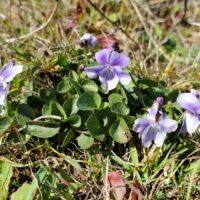
Viola adunca
Native to both coastal and mountain plant communities, this violet can be seen locally blooming in coastal meadows and bluffs. Forms low-growing, slowly creeping, neat clumps of heart-shaped leaves. Sweetly fragrant, nodding, blue to purple flowers with white interiors and purple nectar guides bloom in the spring. This pretty little wildflower is visited by bees and other pollinators and is a host plant for a number of butterflies, some of which are rare and endangered. Grows in sun along the coast and light shade inland with moderate summer water. Can reseed if happy.

Viola palustris
Native to moist environments in both coast and mountain plant communities of N. America and Eurasia. Rare in California, where it is found in the northern counties of Mendocino, Humboldt and Del Norte. Rounded to heart shaped leaves with shallow scalloped edges grow from basal rosettes and spread by slender rhizomes. The charming flowers bloom April through July and range from white through lavender in color with dark-purple nectar guides. Used by Fritillary butterflies as a larval food source. Easy to grow, this is not a violet for heavy shade, but prefers brighter locations with light shade and moist, but well drained soils.